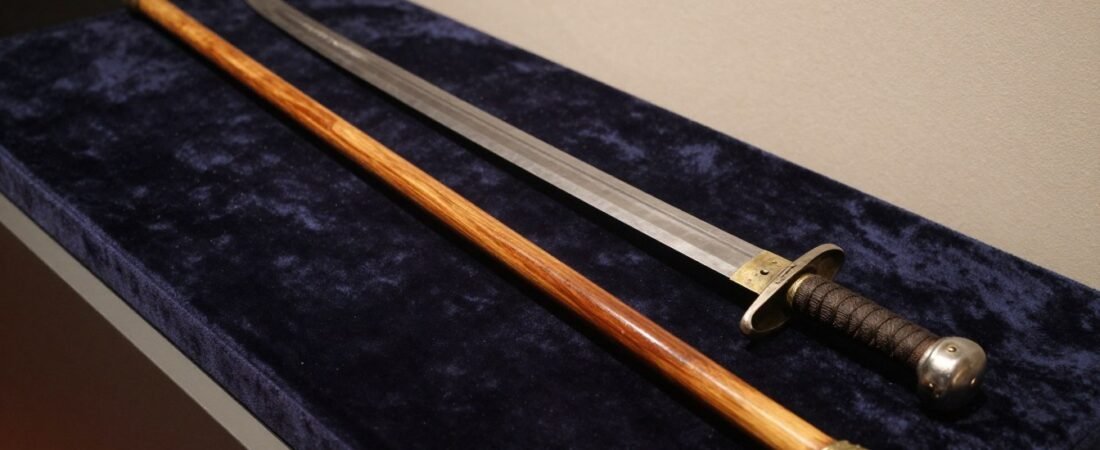
Mechanics and Training Role of the Gatka Stick (Soti and Marahati)
The Gatka stick serves as the fundamental pedagogical tool within the Sikh martial art known as Gatka. Constructed primarily from fire-hardened bamboo, rattan, or dense cane, the standard soti measures roughly three to three and a half feet in length and features a hand guard wrapped in thick leather or cordage. The flexibility of cane absorbs mechanical shocks during high-velocity impacts, protecting the joints of practitioners during extended drills while simulating the basic reach and perimeter defensive lines of edged combat.
A longer, unpadded wooden variation called the marahati represents an alternate training standard used to develop forearm stamina, rotational shoulder strength, and fluid circular patterns known as pentra. Practitioners move through four-directional footwork grids that teach simultaneous balance and weapon trajectory control. In paired drills, the stick is almost universally paired with a small circular buckler known as the fari, formed from pressed rawhide and packed with cotton or wool padding to deflect repetitive strikes without sustaining damage.
The soti is explicitly a training simulator rather than an offensive battle weapon. Its lightweight structure allows participants to learn defensive interception angles, rhythmic footwork, and spatial awareness before transitioning to heavier bladed implements.
Instructional progressions with the soti emphasize non-telegraphed striking arcs and figure-eight loops. By reducing the physical hazard associated with live blades, the stick allows students to build muscular memory, test reaction timing, and internalize parrying angles safely. Practitioners progress from static sequence memorization to dynamic sparring matches where fluid posture shifts determine control over the combat radius.
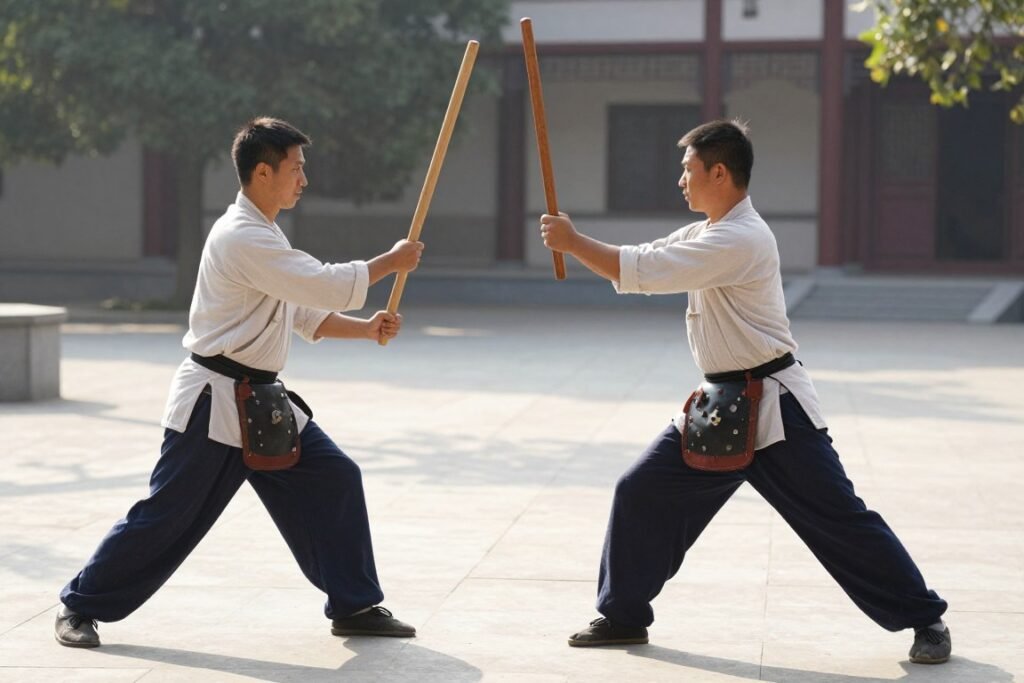
Practitioners use the soti and padded fari buckler to develop defensive timing and continuous movement patterns.
The Khanda: Design, Battlefield Legacy, and Spiritual Emblem
The Khanda is an ancient indigenous South Asian broadsword characterized by a straight, double-edged steel blade that widens toward a blunt or spatulate tip. Unlike tapered thrusting swords, the Khanda possesses significant mass along its forward section, generating tremendous cutting momentum during sweeping, downward cleaves. Structural reinforcement plates, often referred to as reinforcing spines, run along both faces of the blade to stiffen the tempered metal against catastrophic fracturing during shield or armor contact.
A distinctive feature of the classical Khanda is its specialized hilt construction, known as the Hindu basket hilt. This assembly features an integrated knuckle guard, broad side quillons, and an extended pommel spike that permits two-handed leverage during heavy engagement or close-range pommel strikes. The double-edged architecture reflects uncompromising offensive intent, allowing the wielder to execute cuts on both forehand and backhand trajectories without altering hand orientation.
- Structural Geometry: Straight, parallel edges terminating in a broad cutting profile designed primarily for heavy chopping impacts against armored opponents.
- Basket Hilt Integration: Enclosed metal guard shielding the fingers and wrist, paired with a rear projecting spike for dual-grip leverage.
- Reinforced Spine: Metal side-stiffeners riveted along the blade’s central axis to minimize bending stress during combat.
- Sacred Emblematic Status: Visual anchor of the composite Sikh insignia, signifying the divine cut between truth and falsehood.
Beyond its functional history on the battlefield, the Khanda occupies a central position within Sikh theology and heraldry. Guru Gobind Singh utilized the double-edged sword to stir the nectar (Amrit) during the creation of the Khalsa brotherhood at Anandpur Sahib. In contemporary Sikh iconography, the central double-edged blade lends its name to the entire universal emblem, surrounded by a circular chakram and flanked by two curved swords representing Miri and Piri, the balance between temporal authority and spiritual sovereignty.
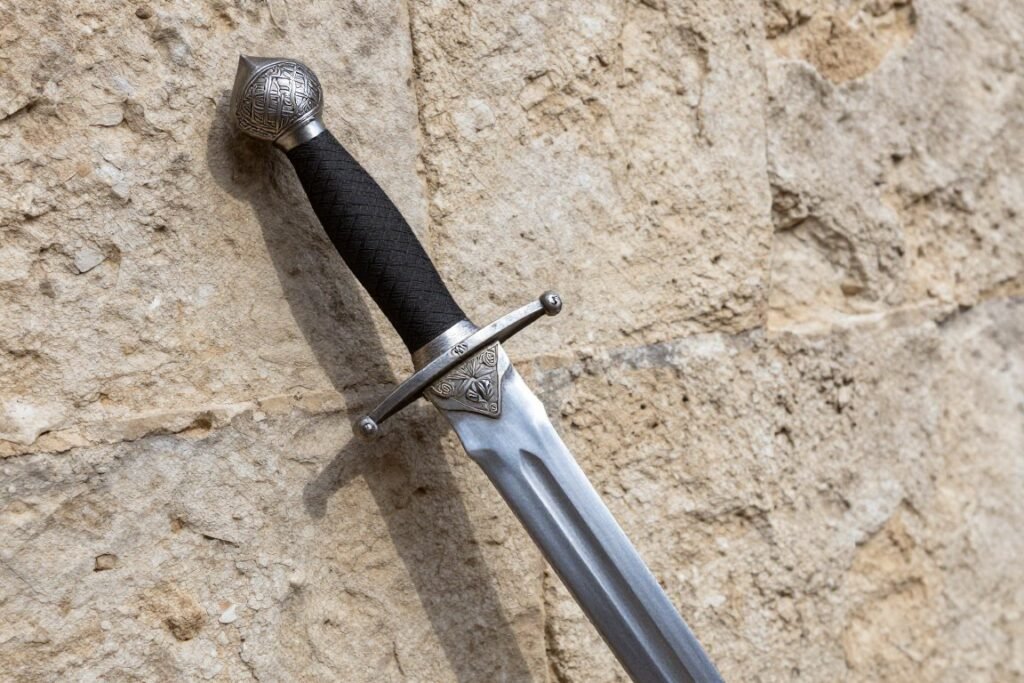
The straight double-edged blade and broad knuckle guard of the Khanda provided immense cutting power in historical close combat.
Comparative Blade Dynamics: Khanda, Talwar, and Kirpan
Distinguishing the Khanda from other traditional Sikh edged weapons requires examining differences in blade curvature, operational function, and theological mandate. While the Khanda features an unbending, double-edged cutting plane, the classic military sword of the region is the Talwar, a curved single-edged saber influenced by Indo-Persian metallurgical developments. The curve of the Talwar facilitates slicing cuts by drawing the blade edge across flesh or textile armor, whereas the Khanda delivers crushing, cleaving strikes.
The Kirpan occupies a unique category separate from standard military sidearms. While a Talwar served primarily as an instrument of cavalry or infantry skirmishing, the Kirpan is an obligatory article of faith (Kakkar) carried by initiated Sikhs as a sacred duty to defend righteousness and protect the vulnerable. While early historical Kirpans often shared blade geometries with short Talwars or Khandas, modern versions are typically compact, sheathed daggers worn under or over clothing, retaining profound sacramental authority rather than functioning as offensive weapons of war.
| Implement | Blade Type | Primary Function | Distinctive Role |
|---|---|---|---|
| Gatka Stick | Blunt Cane | Sparring Drills | Simulates weapon angles safely |
| Khanda | Straight Double-Edged | Battlefield Cleaving | Sacramental blade and sovereignty emblem |
| Talwar | Curved Single-Edged | Draw-Cut Slashing | Primary cavalry and infantry saber |
| Kirpan | Variable Dagger | Spiritual Obligation | Mandatory article of faith for initiated Sikhs |
The physical handling characteristics of these implements diverge sharply across combat scenarios. The curved Talwar relies on wrist indexing and velocity to penetrate through draw cuts, requiring an open arc of clearance. Conversely, the straight Khanda relies on balance points situated further forward, allowing heavy mechanical shocks that can disable shields, while the soti replicates these timing constraints without lethal hazard.
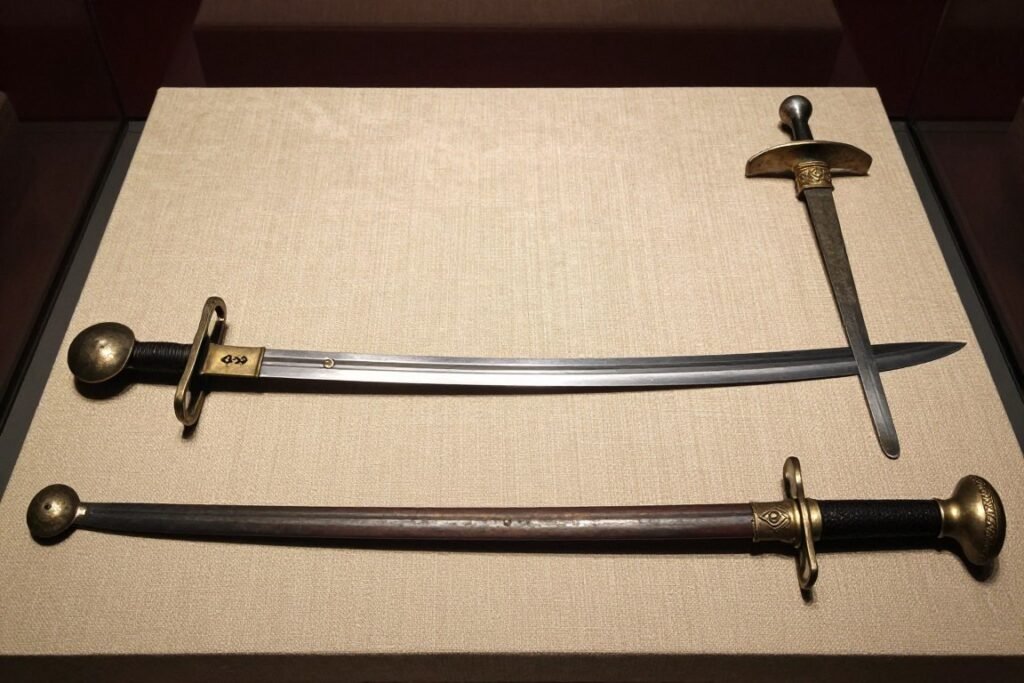
Comparing the curved profile of the Talwar, the broad geometry of the Khanda, and the devotional form of the Kirpan.
Historical Evolution and the Transition to Modern Sport
The codification of Sikh armed arts began under Guru Hargobind, who introduced the twin swords of Miri and Piri to signify that spiritual devotion must be defended with physical capability. This warrior tradition crystallized under Guru Gobind Singh, who established centers of military and philosophical training at Anandpur Sahib. Warrior orders, notably the Akali Nihangs, maintained an expansive martial system referred to as Shastar Vidiya, which integrated swords, spears, composite bows, and daggers into a cohesive combat discipline.
During the British colonial period following the annexation of Punjab in the mid-19th century, authorities enacted strict disarmament policies that severely curtailed the open bearing of traditional weapons. To preserve operational knowledge without violating colonial edicts, practitioners increasingly emphasized stick-fighting methods derived from regional stick-play systems. This adaptation gave rise to the formalized, stick-centric practice that contemporary audiences identify as Gatka.
Early Martial Schools
Guru Hargobind and Guru Gobind Singh integrated weapon mastery with high ethical conduct, establishing permanent martial centers across Punjab.
19th-Century Shift
Colonial bans forced weapon arts into private preservation, encouraging wooden sparring tools to replace live steel blades in public practice.
Institutional Revival
Reformers like Kartar Singh Akali modernized competitive curricula, leading to structured school leagues and university tournaments.
The twentieth century brought further institutionalization as organizations formalized safety protocols and competitive rulebooks. The Punjab Gatka Association and the Gatka Federation of India worked alongside the World Gatka Federation to codify the discipline into a modern contact sport. Today, inter-varsity Gatka tournaments test athletes in standardized arenas, utilizing uniform protective gear, calibrated wooden sticks, and objective point-scoring systems.
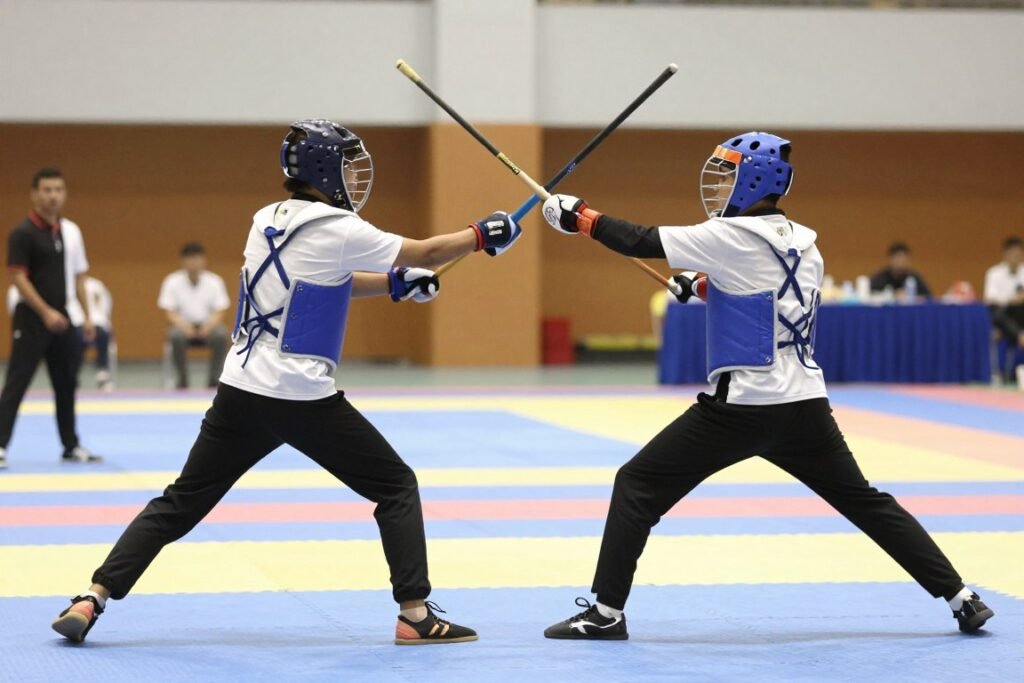
Modern inter-varsity tournaments feature standardized scoring, protective gear, and regulated wooden soti sticks.
Distinguishing Sport, Ritual Display, and Combat Discipline
Modern public encounters with Gatka typically occur during religious processions known as Nagar Kirtans or cultural festivals such as Hola Mohalla. During these events, martial artists perform acrobatic stick routines, choreographed paired drills, and dramatic spinning demonstrations. While visually captivating, these public exhibitions differ substantially from both regulated athletic tournaments and the historical science of battlefield weapon deployment.
Conflating tournament stick fighting with historical battlefield methods obscures the operational realities of steel weapons. The light weight of a cane soti encourages rapid tapping techniques that cannot replicate the balance, edge alignment, and momentum required to handle an authentic steel Khanda.
A subject of enduring debate among military historians involves the exact origin of Gatka itself. Some scholars and traditionalists argue that Gatka originated strictly as an abbreviated training drill inside Shastar Vidiya, intended solely to introduce novice recruits to primary evasion angles. Others suggest that the 19th-century colonial environment essentially created modern Gatka by isolating the stick-fighting component from the wider, suppressed repertoire of lethal battlefield techniques.
Within traditional communities, ceremonial weapons undergo meticulous consecration and respectful storage, reflecting their sacred standing. A Khanda or Talwar displayed during religious ceremonies represents the defense of human dignity, whereas the competitive soti functions within a secular sporting framework designed to cultivate physical fitness, reflexes, and cultural pride among younger generations.
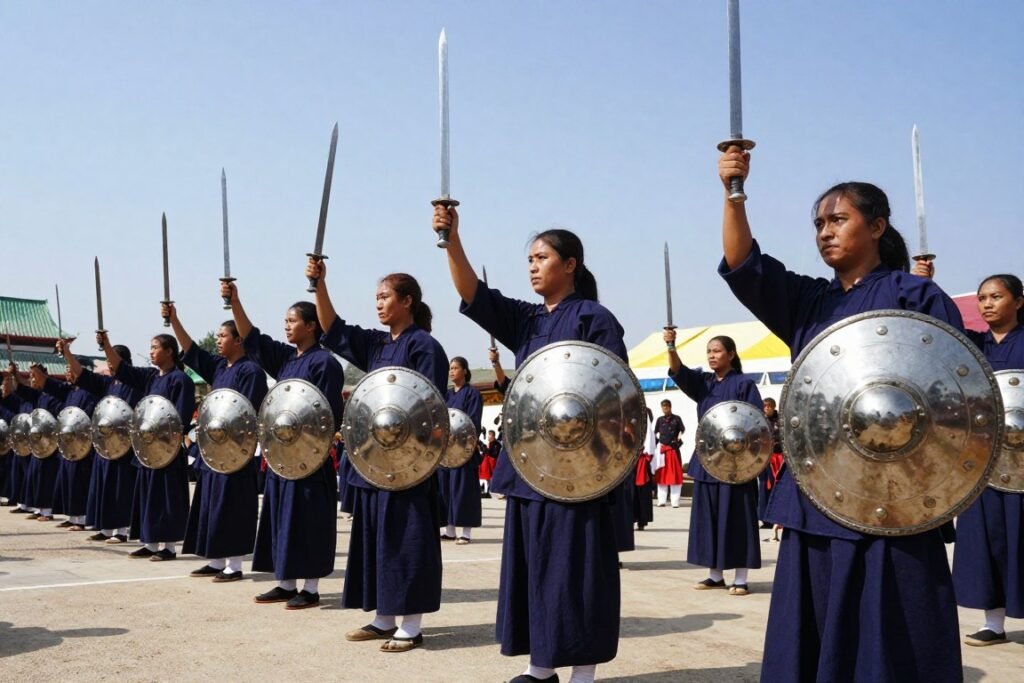
Public festival displays showcase cultural preservation, contrasting with the technical demands of historical blade handling.
Frequently Asked Questions
What materials are used to construct an authentic Gatka stick?
An authentic soti is constructed from seasoned cane, bamboo, or rattan to absorb shock during repeated contact. The handle area features a padded leather or wound-cord basket guard that shields the fingers from direct impacts.
Is the Khanda sword identical to the Sikh religious symbol?
The religious symbol incorporates a central double-edged Khanda sword surrounded by a circular chakram and two curved swords. While the emblem takes its name from the central blade, the weapon itself is a physical double-edged broadsword used in historical combat.
How does a Kirpan differ legally and functionally from a Khanda?
The Kirpan is an obligatory article of faith mandated for initiated Sikhs to wear as a religious duty rather than an active weapon of war. The Khanda is a broad battlefield sword characterized by a long, heavy blade and basket hilt used historically in military engagements.
Why did wooden sticks replace live blades in popular practice?
British disarmament laws enacted in the 19th century banned the open carrying and training of live steel weapons across Punjab. Practitioners adapted their techniques to wooden implements like the soti to preserve their footwork and movement traditions under colonial restrictions.
What rules govern competitive Gatka stick matches today?
Modern matches occur within designated rings where competitors score points by landing controlled strikes on authorized target areas while carrying standard soti sticks and bucklers. Officials penalize excessive force, grappling, or strikes to unprotected anatomical zones to support competitor safety.
The Living Legacy of Sikh Martial Arts
The Gatka stick and the Khanda illustrate the deliberate connection between practical instruction, historical martial survival, and lasting spiritual values. By maintaining clear distinctions between sporting stick drills, classical swordsmanship, and sacred ceremonial articles, practitioners honor the functional lineage of these weapons while preserving their cultural significance. Through structured education and disciplined study, these time-tested traditions continue to foster resilience, community identity, and physical mastery across the modern world.