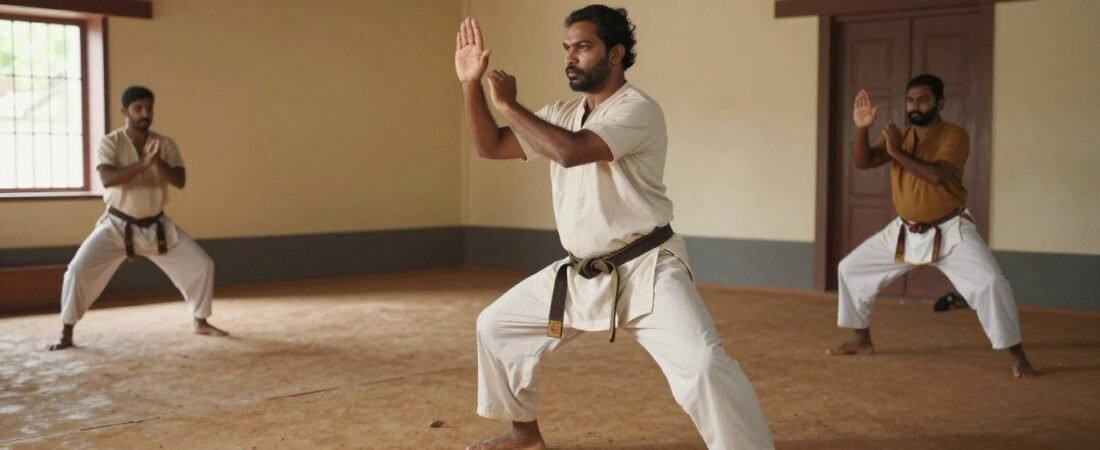
The purpose of this article is education. Mythological accounts, traditional healing ideas, and modern scientific findings are identified separately.
Key Takeaways
- Kalaripayattu is a traditional Indian martial art strongly associated with Kerala and wider South Indian practice.
- The name is commonly explained through kalari, meaning training arena, and payattu, meaning practice, exercise, or combat training.
- Traditional accounts connect the art with figures such as Parashurama and Agastya, but these stories belong to cultural and mythological memory rather than confirmed historical evidence.
- Training is often described through four progressive stages: Meithari, Kolthari, Ankathari, and Verumkai.
- The northern, southern, and central styles are broad categories. Individual schools may combine features from more than one tradition.
- Training can develop mobility, balance, coordination, lower-body strength, focus, and body awareness when taught progressively.
- Weapons, vital-point concepts, massage, and traditional healing require qualified instruction and should not replace modern medical care.
1. Introduction: What Is Kalaripayattu?
Kalaripayattu is a traditional Indian martial art associated most closely with Kerala. It combines physical conditioning, combat movement, weapons practice, mental focus, ritual discipline, and traditional therapeutic knowledge. Some schools also preserve performance forms that display jumps, spins, kicks, weapons, and precise floor patterns.
The word is often linked to two Malayalam terms. Kalari refers to a training arena, while payattu refers to practice, exercise, or combat training. The exact explanation can vary with language, region, and lineage. In practical terms, the name points to a disciplined system taught in a dedicated space.
Body awareness as a central principle
One phrase associated with the art is meyy kanavanam, often translated as “Make the body an eye.” The phrase expresses total body awareness. A student learns to notice weight, direction, balance, distance, breath, and timing rather than relying only on arm strength.
This principle helps explain why Kalaripayattu includes more than fighting. Repeated movement patterns train the body to move with control. Concentration supports memory and timing. Respect for the Gurukkal, or teacher, gives the practice a clear ethical and educational structure.
What a modern class may include
- Warmups and mobility work for the hips, shoulders, ankles, and spine.
- Conditioning drills that develop balance, coordination, and strength.
- Footwork patterns and controlled sequences.
- Partner exercises performed at a suitable pace.
- Wooden-weapon practice before advanced metal weapons.
- Breathing, concentration, and traditional etiquette.
- Performance or demonstration forms in some schools.
2. History, Lineage & Sacred Kalari Architecture
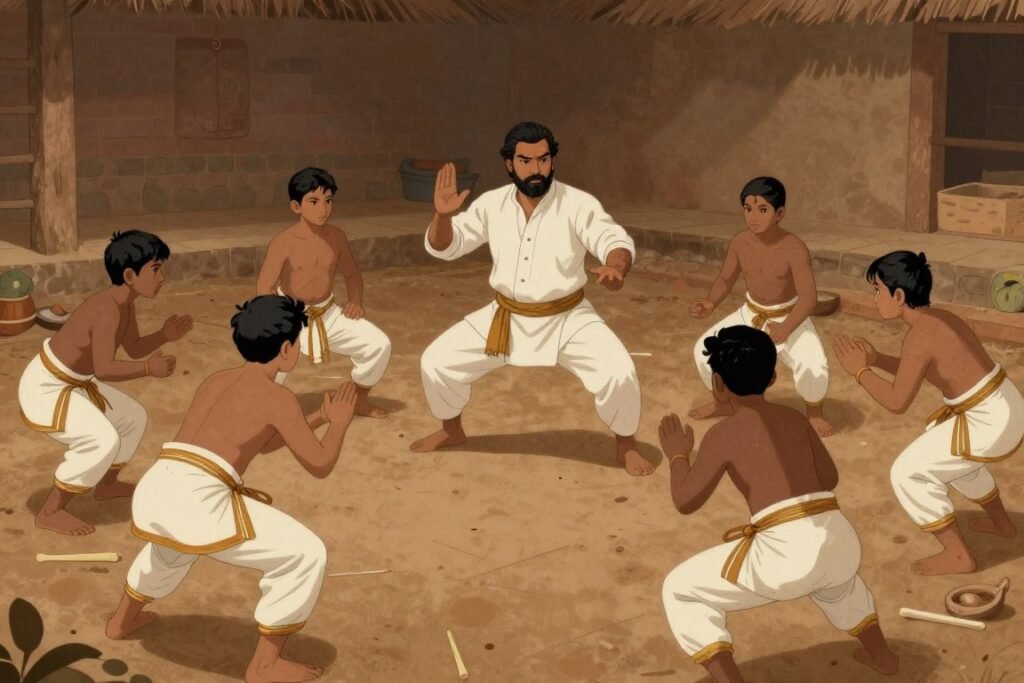
The history of Kalaripayattu includes oral tradition, regional memory, warrior culture, colonial disruption, performance practice, and modern revival.
Mythological origins and traditional memory
Many traditional accounts connect the creation or spread of the kalari with Parashurama, a figure in Hindu mythology associated with Kerala’s formation. Other stories emphasize Agastya, a revered sage linked with southern knowledge traditions. These narratives are important to the cultural identity of the art, but they should not be presented as documentary proof of a single historical beginning.
Lineages frequently preserve accounts of teachers, warriors, healers, and local champions to pass down identity and values. While these stories vary between districts and family traditions, a careful historical approach keeps them visible while distinguishing them from written records and archaeological evidence. Furthermore, written documentation remains incomplete because knowledge historically moved through direct teacher-student instruction rather than standardized manuals, explaining why modern schools often share core principles despite using varied terminology and sequences.
Warrior culture and medieval practice
In medieval Kerala, martial training was connected with local political communities, bodyguards, regional contests, and armed service. Training could support both practical defense and public demonstrations of skill. The art was not isolated from society. It existed within systems of land, family, patronage, religion, and local authority.
The colonial period and the 1804 ban
British colonial authorities restricted martial practice in Kerala. The 1804 ban is often identified as a major turning point. Disarmament policies and political control weakened public training traditions. Some knowledge continued within families and private lineages, while other elements survived through festivals, physical culture, storytelling, and performance.
The effect was not identical everywhere. Some practices declined, while others adapted. It is more accurate to describe the period as disruption and suppression rather than assume that every lineage disappeared.
Modern cultural resurgence
During the twentieth century and after Indian independence, teachers and cultural organizations helped restore public interest. Kalaripayattu entered stage performance, cinema, tourism, physical education, and international martial arts discussion. Modern schools now teach both Indian and overseas students.
This revival creates opportunities and challenges. Greater visibility can support preservation, but it can also simplify a complex art into acrobatics or screen combat. Responsible teaching keeps technique connected to discipline, history, safety, and lineage.
Architecture and Alters
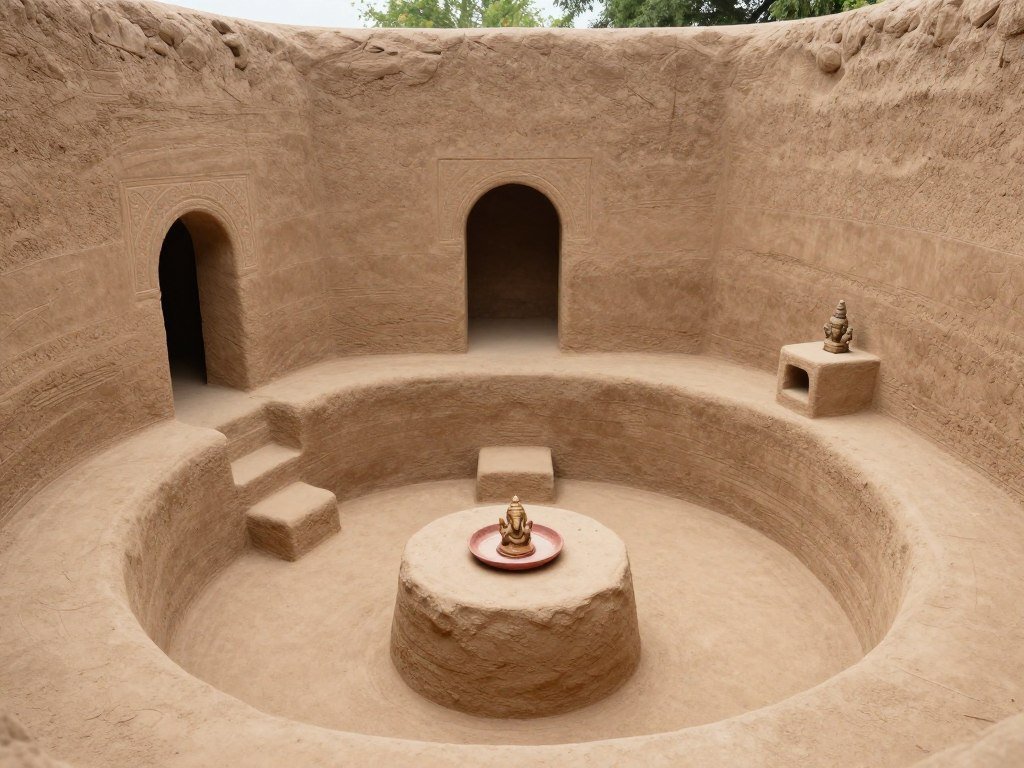
A Kuzhi Kalari is commonly described as a sunken training space. Its design gives the practice a distinct physical and symbolic setting.
Sunken design and traditional measurements
The training pit is often described as about 42 feet long, 21 feet wide, and 4 feet deep. These measurements are traditional references, not universal building rules. Local land, school lineage, renovation, and modern safety needs can change the layout.
The sunken form may help create a protected practice area. It also marks a clear transition from ordinary space into a disciplined environment. Entering the kalari is therefore both a physical movement and a symbolic act. Similarly, sacred features like the Poothara are not decorative elements for visitors; they reflect the deep relationship between training, reverence, memory, and community that students acknowledge through traditional salutations before practice begins.
Altars and their meanings
The Poothara is commonly described as a seven-tiered platform with cosmic and symbolic associations. The Ganapatithara is associated with Ganesha, while the Guruthara honors the teacher lineage. Arrangements and rituals vary by school.
Guru-shishya parampara
The phrase guru-shishya parampara describes a teacher-student lineage. The Gurukkal leads instruction and may carry knowledge received from earlier teachers. Learning is often personal and progressive. A teacher watches a student’s movement, adjusts the pace, and decides when the student is ready for new material. Many modern classes may use schedules, memberships, and group instruction, but the teacher’s role remains important. A good school should explain its lineage, class structure, safety rules, and expectations before asking a beginner to attempt demanding exercises.
3. The Four Progressive Stages of Kalari Training
Many descriptions organize training into four stages. The sequence is useful, but it is not identical in every lineage. A school may use different names, combine stages, or introduce selected weapons for demonstration. Progress should depend on control and readiness rather than speed.
1. Meithari: body conditioning
Meithari is the foundation of physical training. The word is commonly associated with body exercises and movement preparation. Students work on posture, balance, flexibility, coordination, footwork, and dynamic transitions.
Exercises may include low stances, leg lifts, jumps, turns, stretches, and repeated floor patterns. The goal is not simply to become flexible. Students learn to keep the body organized while changing height, direction, and speed.
Some lineages include oil massage known as Kalari Uzhichil. Traditional massage has cultural and training significance, but its use should be guided by a qualified practitioner. It should not be treated as a proven cure for injury or illness.
2. Kolthari: wooden weapons
Kolthari introduces wooden weapons. Common examples include the long staff or Kettukari, the short stick or Cheruvati, and the curved stick known as the Ottakkol. Wooden weapons allow students to study distance, timing, grip, alignment, and coordination with less danger than sharp metal weapons. A responsible class uses controlled speed, clear boundaries, suitable equipment, and close supervision.
3. Ankathari: metal weapons
Ankathari refers to training with metal weapons. Examples include the dagger known as the Kattaram, sword and shield or Val and Paricha, spears, and the flexible whip-sword called the Urumi. These tools require advanced control. Students should not copy online demonstrations or practice with sharp weapons without direct instruction. Metal-weapon training is a specialist activity. Protective equipment, proper spacing, and a teacher’s assessment are essential.
4. Verumkai: unarmed practice
Verumkai means empty hand. It may include striking, evasion, balance breaking, joint control, throws, grappling, and traditional vital-point concepts. These techniques can be dangerous when practiced carelessly. Modern instruction should place strong emphasis on consent, controlled contact, fall safety, and stopping when a partner signals discomfort. The aim is to develop timing and body awareness, not to encourage violence.
| Stage | Main focus | Skills developed | Safety priority |
| Meithari | Body conditioning and movement | Balance, mobility, coordination, strength | Progressive loading and joint control |
| Kolthari | Wooden weapons | Distance, timing, grip, rhythm | Controlled contact and safe spacing |
| Ankathari | Metal weapons | Precision, coordination, discipline | Qualified supervision and protective measures |
| Verumkai | Unarmed movement | Evasion, balance, grappling, control | Consent, restraint, and partner safety |
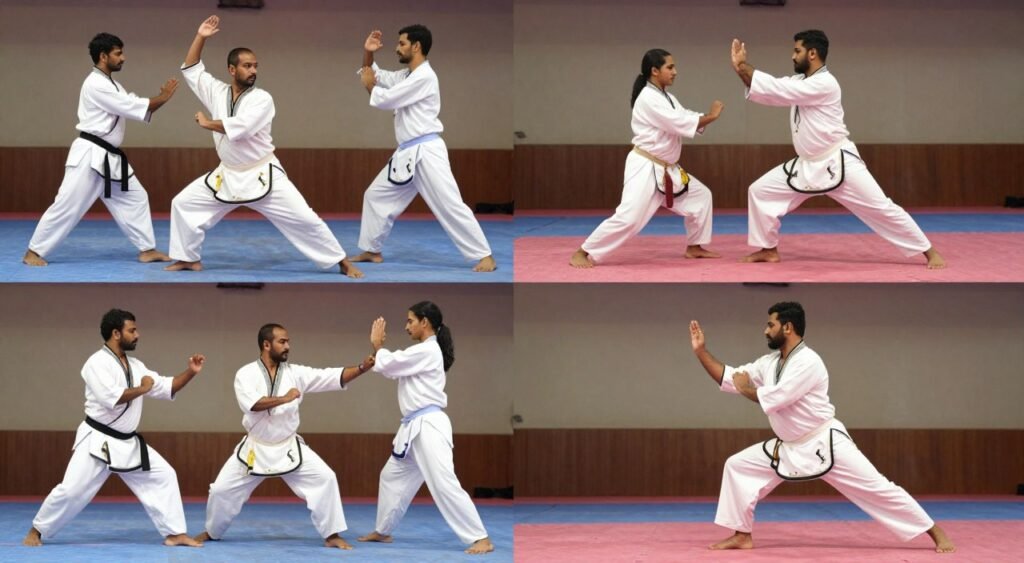
Regional labels are useful for orientation, but they should not be treated as rigid categories. Teachers may preserve overlapping methods.
4. Regional Styles, Weaponry & Animal Biomechanics
Northern (Vadakken) vs. Southern (Thekkan)
The northern style is often called Vadakkan. It is commonly associated with Kerala’s northern regions and with fluid movement, acrobatic forms, long-range striking, and weapons training. The southern style is often called Thekkan and may overlap with Adi Murai, a southern fighting tradition. It is often described as more grounded, direct, and focused on close-range hand methods and vital-point concepts.
The central or Madhya approach is sometimes associated with composite floor patterns called Kalam. These patterns may connect features from neighboring traditions. The labels can be helpful, but school-to-school variation is normal.
| Style or tradition | Region or association | Characteristic movement | Training emphasis | Commonly associated features |
| Vadakkan | Northern Kerala | Fluid, mobile, and often acrobatic | Body conditioning and weapons | Long-range movement, flowing sequences, weapon forms |
| Thekkan | Southern Kerala and nearby southern traditions | Grounded and direct | Close-range unarmed practice | Adi Murai associations, hand methods, vital-point concepts |
| Madhya | Central or blended traditions | Composite floor patterns | Integrated movement vocabulary | Kalam patterns and overlapping methods |
Why style labels matter
Style names help students ask better questions. A beginner can ask which lineage a school follows, what stages it teaches, how it explains its history, and how much time it gives to conditioning, weapons, performance, or unarmed work.
Labels should not be used to rank one tradition as superior. Each has its own teaching goals, vocabulary, and cultural setting. The quality of instruction matters more than a dramatic label.
Tactical Breakdown of Traditional Weapons (Ottakkol, Kuntham, Urumi)
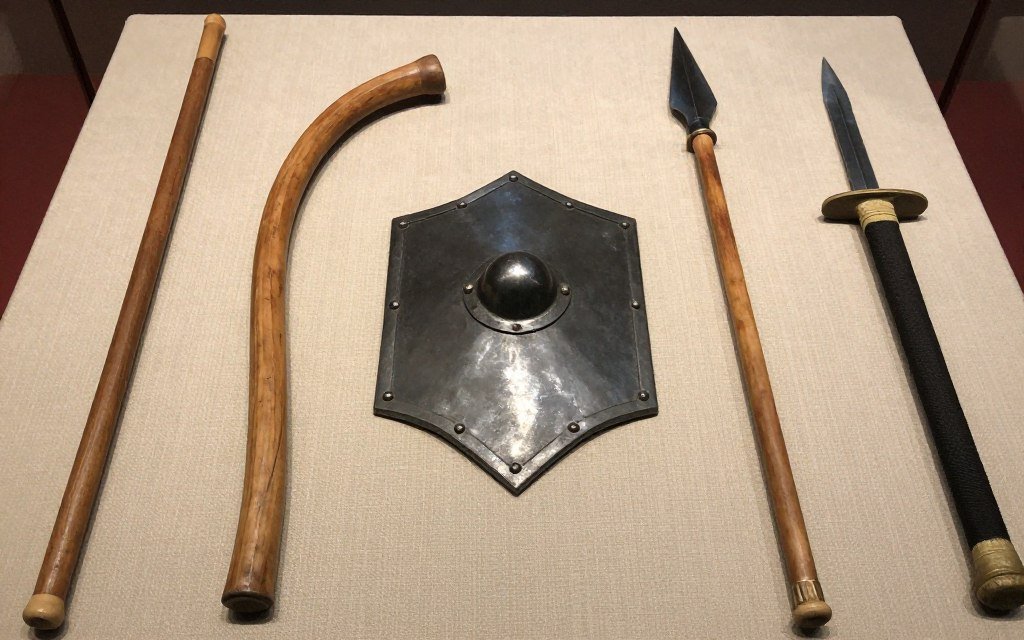
Weapons in Kalaripayattu are studied as extensions of movement. Their use demands discipline, distance awareness, timing, and control.
From wood to metal
Wooden weapons generally provide a bridge between empty-hand movement and more dangerous tools. Students learn how an object changes reach, balance, rhythm, and defensive responsibility. The weapon does not replace body skill. It makes poor alignment and careless timing easier to notice. For example, training with the Kuntham (spear) highlights distance, posture, and line control; while historical battlefield use differs from modern classroom practice, reputable schools utilize safe replicas or padded equipment to preserve these tactical principles.
The Ottakkol
The Ottakkol is a curved stick associated with Kalaripayattu. Its shape changes the geometry of movement. It can encourage circular pathways, unusual angles, and close attention to range. A technical understanding is best developed through supervised drills rather than independent experimentation.
The Urumi
The Urumi is a flexible whip-sword. It is one of the most visually striking weapons connected with the art, but it is also extremely demanding. Its flexible blade creates risk for the user and everyone nearby. It should never be treated as a prop for unsupervised practice.
Weapon safety note
Do not attempt Kalaripayattu fighting techniques with sharp weapons after watching a video. Weapon training requires a qualified instructor, suitable equipment, controlled space, and a progression that matches the student’s ability.
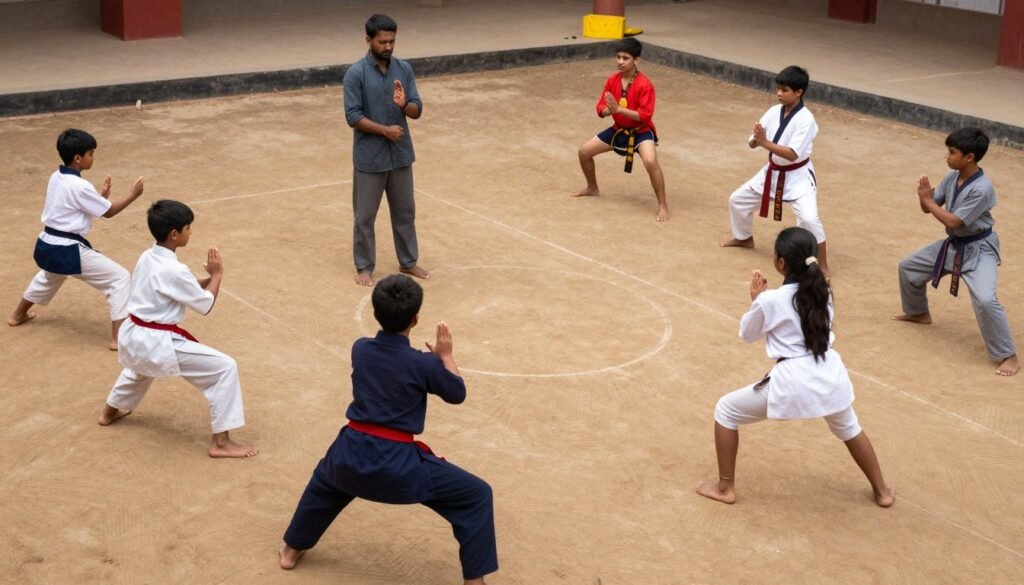
Ashta Vadivukal refers to eight animal forms or postures in many descriptions. Names and classifications may vary by school.
Animal postures connect physical qualities with symbolic images. A student may study the grounded stability of an elephant, the alert quality of a lion, or the low movement of a serpent. These images help make complex movement memorable.
Examples of the eight forms
| Animal stance | Movement idea | Commonly engaged areas | Basic physical benefit |
| Gaja | Grounded weight and stable transitions | Hips, thighs, trunk | Lower-body strength and balance |
| Simha | Alert posture and strong extension | Shoulders, back, legs | Postural control and coordination |
| Sarpa | Low, fluid, undulating movement | Spine, hips, shoulders | Mobility and body awareness |
| Marjara | Light changes of level and direction | Wrists, hips, ankles | Agility and coordination |
| Ashva | Forward drive and balanced stance | Thighs, calves, core | Leg strength and stability |
| Mayura | Controlled balance and reach | Core, legs, shoulders | Balance and concentration |
| Matsya | Continuous turning and flowing change | Trunk, hips, legs | Coordination and mobility |
| Vriksha | Upright rooting and single-leg control | Feet, ankles, hips | Posture and proprioception |
Kalkal and joint conditioning
Kalkal refers in some descriptions to dynamic leg and movement drills. These exercises may challenge the hips, knees, ankles, and lower back through controlled changes of level. They can improve movement capacity for some students, but progress should be gradual.
Mobility work is not a contest. A deep stance or high kick is not automatically better. Pain, swelling, sharp discomfort, or repeated strain should be taken seriously. Beginners should ask for modifications based on age, fitness, and injury history.
5. Marma Vidya & Kalari Chikitsa (Healing Science)
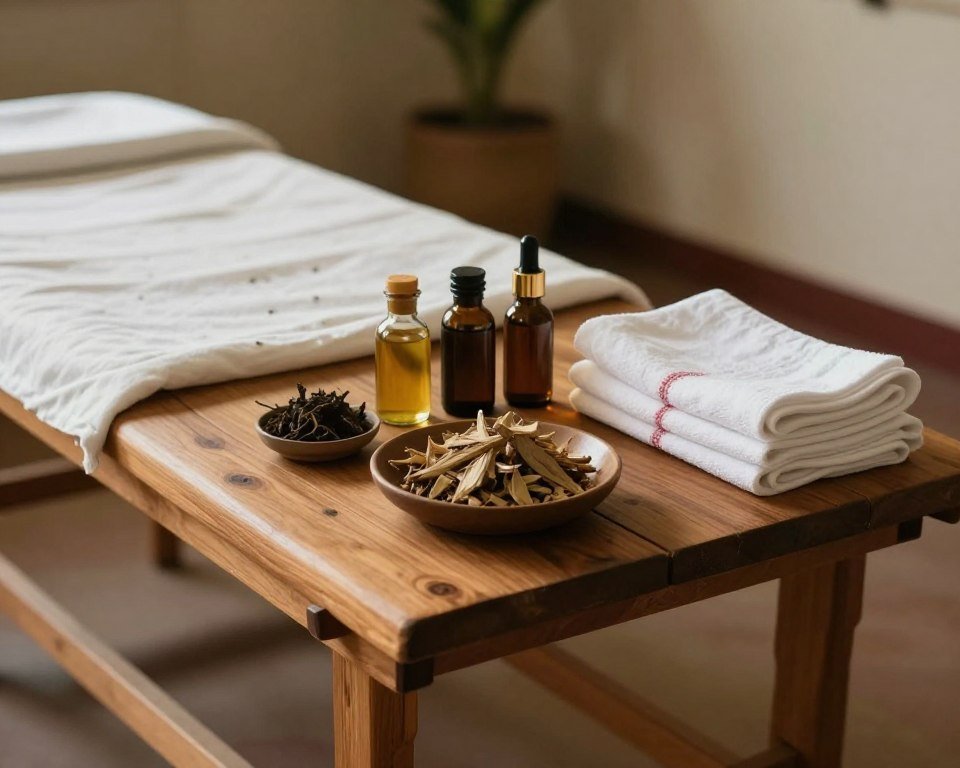
Marma Vidya and Kalari Chikitsa are traditional knowledge systems. Their cultural importance should be respected, while medical claims should be evaluated through modern evidence and professional care.
Anatomy of Marmas (Vital Points) & Adanga
Marma Vidya concerns marmas, often described as vital points where physical structures, nerves, vessels, or energy pathways meet. Different traditions refer to 107 or 108 marmas. The number and interpretation depend on the lineage.
Traditional descriptions are not identical to modern anatomy. A marma may carry symbolic, energetic, and physical meanings at the same time. Readers should not use pressure-point charts to diagnose illness or attempt dangerous techniques on another person.
Kalari Chikitsa & Medicated Oil Massages
Kalari Chikitsa refers to traditional therapeutic practices connected with the kalari. These may include herbal oils, massage, poultices, and recovery routines. Chavitti Uzhichil is a massage method associated with foot pressure in some traditions. Kizhi refers to a poultice or bundled herbal preparation used in certain treatments.
Traditional massage may be meaningful for relaxation, cultural continuity, or supervised recovery. However, herbal products can cause reactions, and massage can worsen some injuries or medical conditions. Consult a licensed health professional for pain, trauma, neurological symptoms, infection, or any serious concern.
Adangal is described in some lineages as a group of manual first-aid, recovery, or resuscitation-related methods. Terminology and practice vary. Such knowledge may form part of a teacher’s traditional training, but it is not a substitute for emergency medical services or certified first-aid education.
Evidence and respect can coexist
It is possible to value traditional knowledge without presenting every traditional claim as scientifically proven. Good writing explains the practice, identifies its cultural setting, and avoids promising cures.
6. Beginner Guidance, Safety & Frequently Asked Questions
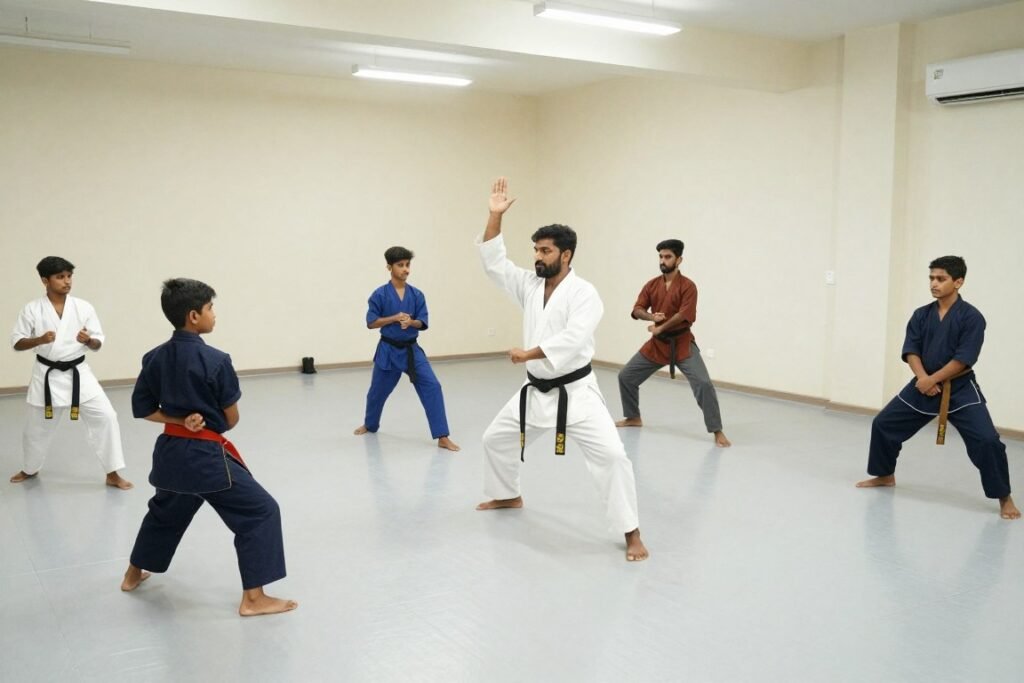
Outside Kerala, students may find traditional schools, cultural organizations, performance groups, or general martial arts studios offering selected Kalaripayattu material.
Questions to ask before joining
- Which lineage or teaching tradition does the instructor follow?
- How long has the instructor taught beginners?
- Does the class begin with conditioning and movement before weapons?
- What safety rules apply to partner work and equipment?
- Are trial sessions available without pressure to purchase a long membership?
- Can the teacher adapt exercises for age, mobility, or injury history?
- Does the school clearly distinguish cultural demonstration from practical training?
- Are fees, schedules, cancellation rules, and class expectations easy to understand?
What to expect in early sessions
Beginners typically spend early sessions mastering fundamental footwork, stance transitions, weight distribution, and basic movement patterns. While this deliberate pace may feel slower than cinematic depictions of the art, it is essential for building joint coordination before adding speed or complexity. Practitioners should focus on comfortable clothing, proper hydration, and patient attendance rather than rushing into high kicks, advanced weaponry, or full-contact drills.
Is Kalaripayattu useful for fitness?
Regular practice may support mobility, coordination, balance, body awareness, and lower-body strength. The result depends on class design, frequency, effort, recovery, and individual factors. It is not necessary to promise a specific medical or athletic outcome.
Safety and Practice
Weapons are not toys
Training weapons can still cause serious injury. Beginners should use approved equipment only under supervision. Sharp blades, flexible weapons, and improvised objects have no place in unsupervised practice.
Respect and consent
Partner exercises require communication. Students should agree on contact level, stop when asked, and avoid using class techniques outside the training context. Traditional respect for a teacher should never prevent a student from reporting unsafe behavior.
Modern self-defense limits
Kalaripayattu may develop coordination, awareness, confidence, and physical skills, but no martial art guarantees safety in a real confrontation. Self-defense also involves avoidance, de-escalation, escape, legal judgment, and emergency planning.
Readers should follow the laws of their location. They should not use training as permission to carry weapons or provoke a fight. The safest outcome is often to leave the situation and seek help.
Frequently Asked Questions (FAQs)
Is Kalaripayattu practical for modern self-defense?
It can contribute to physical coordination, movement awareness, confidence, and controlled partner practice. Practical self-defense depends on the instructor, training quality, regular practice, situational awareness, legal context, and the ability to avoid or de-escalate danger. Traditional techniques should not be treated as guaranteed solutions. A realistic program should include safety, escape, communication, and responsible decision-making.
What is the difference between Kalaripayattu and Silambam?
Kalaripayattu is strongly associated with Kerala and includes body conditioning, unarmed methods, wooden weapons, metal weapons, animal postures, and traditional healing knowledge. Silambam is a South Indian martial tradition strongly associated with Tamil regions and is especially known for staff-based movement. Both are diverse, and their actual practice varies by school. There can be overlap in footwork, weapon handling, performance, and regional exchange, so simple comparisons should not erase lineage differences.
Is Kalaripayattu suitable for beginners, older adults, or those with limited mobility?
Yes. While cinema and public demonstrations often highlight high acrobatic kicks and fast weapon duels, the foundational Meithari stage is built around adaptable body mechanics. Under qualified supervision, a Gurukkal will adjust training intensity, stance depth, tempo, and movement patterns based on a student’s age, current fitness, flexibility, and injury history. Beginners do not need to rush into weapons or advanced kicks; instead, consistent basic training—such as dynamic stretches, low-impact footwork, and breathing exercises—is far more effective for safely developing mobility, balance, joint health, and core stability than forcing deep positions or high-speed techniques.
Is Kalaripayattu only a fighting system?
No. It includes combat traditions, but also movement education, concentration, ritual practice, performance, teacher lineage, and traditional therapeutic knowledge. Different schools place different weight on each part. A complete explanation should include both the martial and cultural dimensions.
How long does it take to become proficient?
There is no single timeline. Pprogress depends on attendance, physical preparation, teaching quality, the school’s curriculum, and the student’s goals. A beginner can gain useful movement skills early, while advanced weapon and unarmed work may require years of steady practice. A responsible instructor avoids promising mastery after a fixed number of sessions.
What is the traditional clothing worn during Kalaripayattu training?
Students traditionally wear a specialized cotton loincloth known as a Kachha (or Kacha). Wrapped tightly around the waist, lower abdomen, and groin using specific binding techniques, the Kachha provides core support, stabilizes the lower back during deep stances, protects vital organs during falls, and allows unrestricted leg movement during dynamic Kalkal drills.
How does this ancient Indian art compare to other Asian martial arts systems?
As an ancient Indian fighting system, Kalaripayattu is often studied alongside other Asian martial arts like Chinese Kung Fu or Japanese Karate. While many modern martial arts focus heavily on ring combat or point sparring, this South Indian martial art prioritizes movement fluidity, lower-body balance, and weapon-based combat techniques. The defensive principles and body conditioning in traditional martial arts across Asia share historical links, but Kalaripayattu retains a distinct focus on architectural layout, animal postures, and traditional healing.
What makes Kalaripayattu distinct from other traditional martial arts?
What sets this martial art apart from other Asian martial disciplines is its holistic integration of combat forms, traditional medicine, and physical culture. Students do not simply learn striking or grappling techniques; they study biomechanics, footwork patterns, and weapon progression. Compared to purely sport-oriented martial arts, Kalaripayattu preserves a deep connection between martial application, movement aesthetics, and body conditioning.
Do I need prior experience in other martial arts to start training??
No prior background in martial arts is required. Beginners learn foundational movement patterns, flexibility drills, and basic stance work step by step. Practitioners transitioning from other martial arts often find that the low stances and dynamic kicking techniques complement their existing body awareness, but complete novices can safely learn the core principles under qualified supervision.
Finding a Responsible School or Instructor
A good school makes its expectations clear. It explains who teaches, what the class includes, how students progress, and which activities are suitable for beginners. It should also maintain a respectful environment for people from different backgrounds.
Check the teacher
Look for a clear background, consistent teaching history, and an ability to explain lineage without exaggerated claims.
- Relevant training experience
- Beginner-focused instruction
- Clear safety rules
- Respectful communication
Check the class
Observe whether students warm up, receive corrections, and practice at a controlled pace before advanced work is introduced.
- Suitable training space
- Progressive exercises
- Supervised partner work
- Safe equipment
Check the offer
A transparent program states its costs and policies. Be cautious of pressure to pay for expensive packages before seeing a class.
- Visible pricing
- Trial or introductory option
- Written schedule
- Simple cancellation terms
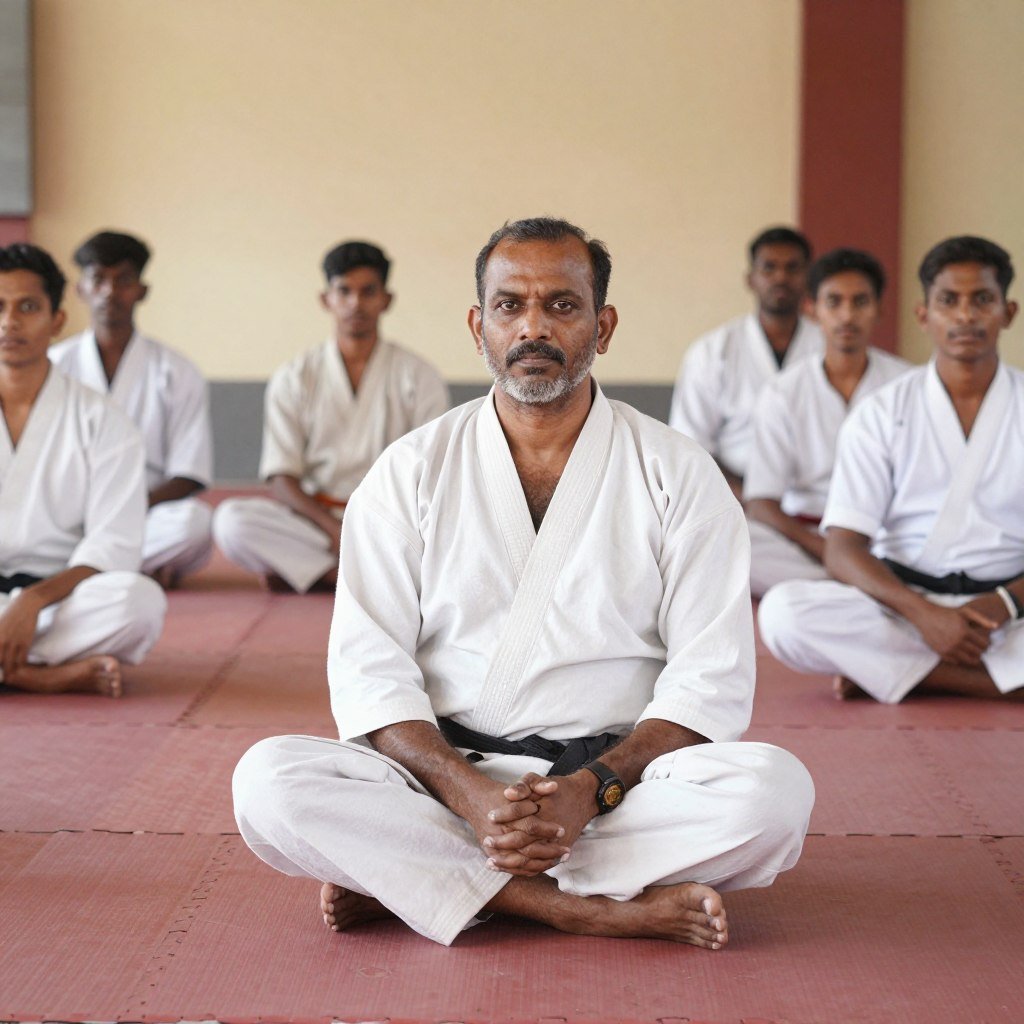
Kalaripayattu remains significant because it connects physical training with history, lineage, regional identity, discipline, and cultural memory.
Why Kalaripayattu Still Matters
Kalaripayattu is more than a collection of fighting techniques. It is a layered Indian martial art shaped by Kerala’s history, South Indian traditions, teacher lineages, performance, weapons, body conditioning, and healing knowledge. Its mythological origins should be understood as cultural tradition, while documented history should be discussed with care.
The four-stage model shows a clear educational idea: build the body first, introduce wooden weapons with control, progress carefully toward advanced tools, and develop unarmed skill through disciplined practice. Northern, southern, and central styles show that the art has never been completely uniform.
For modern students, the strongest benefits may include mobility, balance, coordination, strength, focus, and a deeper connection to a living cultural tradition. These benefits depend on consistent practice and responsible instruction. The best school is not necessarily the one with the most dramatic demonstrations. It is the one that teaches clearly, protects students, respects lineage, and makes progress sustainable. With dedicated practice, martial arts enthusiasts can unlock profound balance, structural alignment, and movement awareness