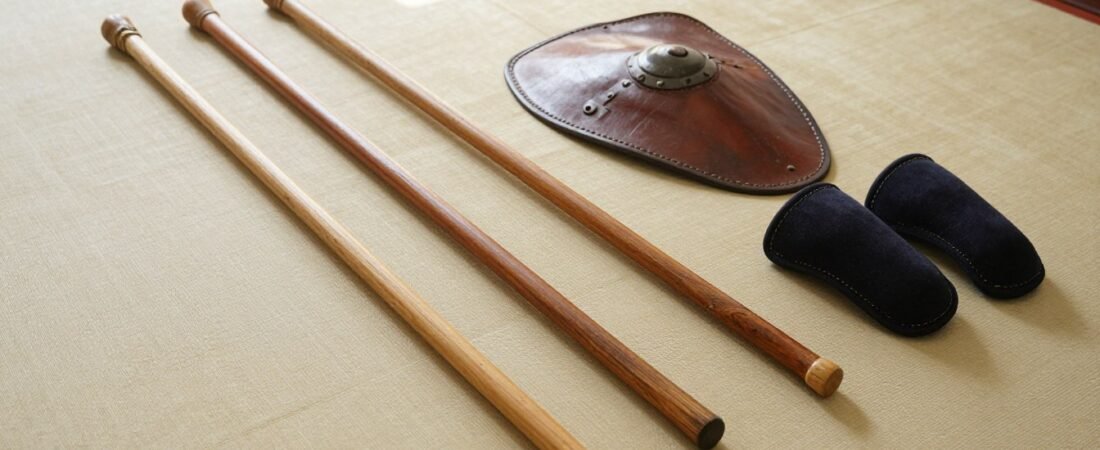
Proper study of these implements balances historical awareness with modern safety protocols. Weapon selection in practice depends on student experience, specific drills, and the distinction between training instruments, historic battlefield artifacts, and sacred religious articles.
Historical Foundations of Gatka Weapons
The practice of Gatka developed in northern India as an effective martial system designed to defend righteous values, personal dignity, and religious freedom. Guru Hargobind, the sixth Sikh Guru, introduced the concept of Miri and Piri, representing temporal authority and spiritual sovereignty, which formalized martial training among Sikhs. This ethos expanded under Guru Gobind Singh, the tenth Sikh Guru, who codified defensive readiness as a moral obligation for the community through the establishment of the Khalsa.
Battlefield tactics in historical centuries demanded versatile equipment capable of meeting cavalry charges, archers, and armored infantry. Training methods progressed from supple wooden sticks to heavy steel weapons to maintain hand conditioning and situational reflexes. Weapons in Sikh tradition are regarded with deep reverence, honored not as instruments of aggression, but as defenders of righteousness and protectors of the weak.
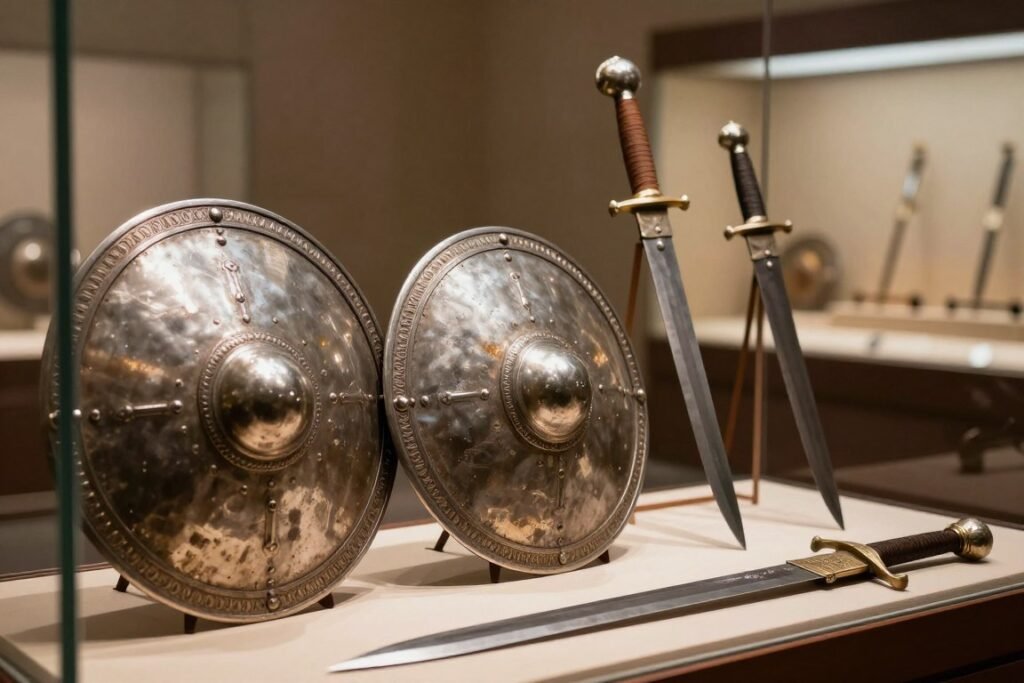
Historical Sikh armaments combined durable steel construction with balanced geometry for battlefield deflection.
Sikh martial philosophy strictly separates the use of force from aggression, treating weapons as defensive tools meant to halt oppression and preserve peace.
Today, martial organizations such as the Gatka Federation promote standard training rules, allowing traditional techniques to survive as organized cultural sports. Contemporary practitioners preserve traditional forms while maintaining ethical frameworks rooted in community service, modesty, and personal discipline.
Wooden Sticks and Staffs in Gatka Practice
Sticks and staffs represent the most accessible training implements in the Gatka curriculum, serving as safe analogues for bladed weapons while building timing, shoulder fluidity, and foot coordination. Through these wooden tools, students absorb the circular patterns and continuous striking lines known as the pantra, which form the mechanical basis for all Gatka arts.
Three primary long tools define distance practice in Gatka, each built from distinct timber and serving specific tactical purposes:
Soti and Marahati
- Soti — long wooden stick: Typically crafted from hardwood, measuring approximately three to three and a half feet, fitted with a leather or cloth hand guard.
- Marahati — bamboo stick: Lightweight and highly flexible bamboo implement used for rapid circular drills and target tracking.
- Develop rapid rotational control from the wrists and elbows.
- Function as primary training simulators for swords without edge hazards.
Lathi Staff
- Lathi — bamboo staff: A sturdy, full-length bamboo staff extending from five to seven feet in length.
- Operated with two hands to deliver leverage-based sweeping and parrying strikes.
- Maintains long-range perimeter control against multiple training partners.
- Conditions the torso core, posture, and planted body balance.
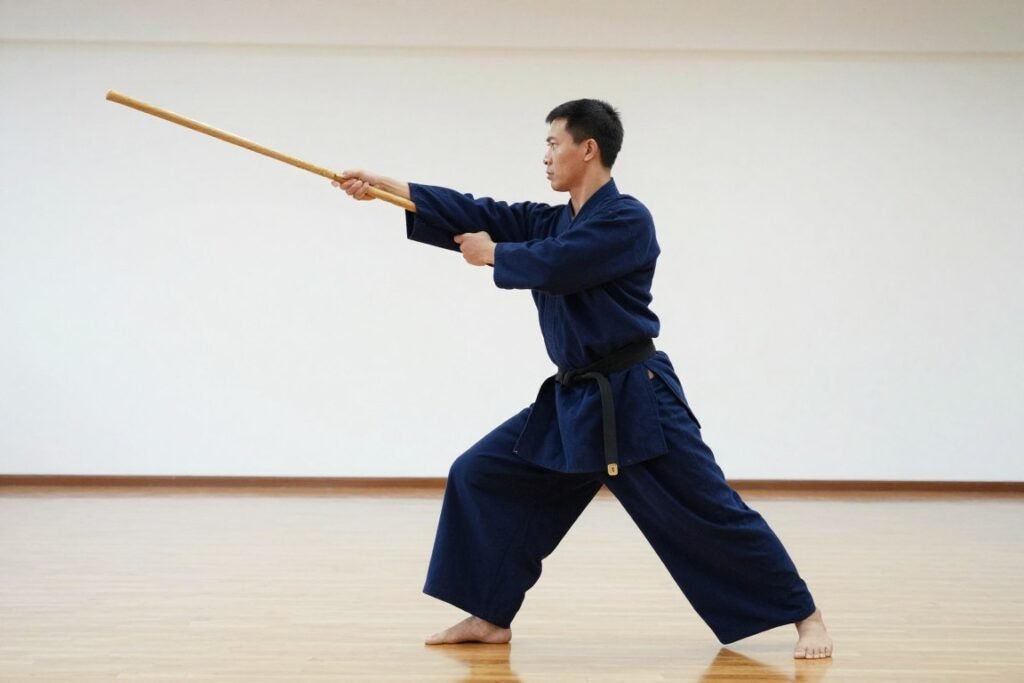
The soti functions as the primary training simulator for sword techniques, allowing fast rotational parrying drills.
The soti serves as the universal foundational implement for Gatka sparring. The hand basket guard on the soti protects the practitioner’s fingers, permitting continuous sparring exchanges without the high risk of hand fractures that standard wooden dowels present. Movement drills with the soti emphasize circular patterns that teach practitioners how to generate defensive coverage around the entire body.
In contrast, the lathi relies on extended leverage rather than wrist rotation. The extra length demands wider stances, grounded foot positioning, and shifting hand placements to redirect incoming strikes. Training with the lathi teaches students how distance control, kinetic energy transfer, and leverage dictate combat outcomes.
Traditional Gatka Shields for Deflection and Parrying
Defensive implements in Gatka embody the philosophy of deflection rather than static resistance. Shields are designed to guide opponent strikes off line while closing the distance or maintaining a defensive shell, transforming incoming momentum into parrying opportunities.
Gatka utilizes two principal shield formats depending on whether the engagement prioritizes mobility or broad body coverage:
- Phari — small shield: A compact, lightweight target shield commonly constructed from boiled leather, dense hide, or woven plant fiber with a central hand grip.
- Dhal — shield: A medium-to-large convex circular shield historically forged from crucible steel or tough animal hide, secured to the arm via twin leather straps and an inner cushion pad.
- Both shields emphasize glancing deflections to redirect strikes rather than absorbing head-on impacts.
- Training versions use thick padding to prevent injury to training partners during close-range exchanges.
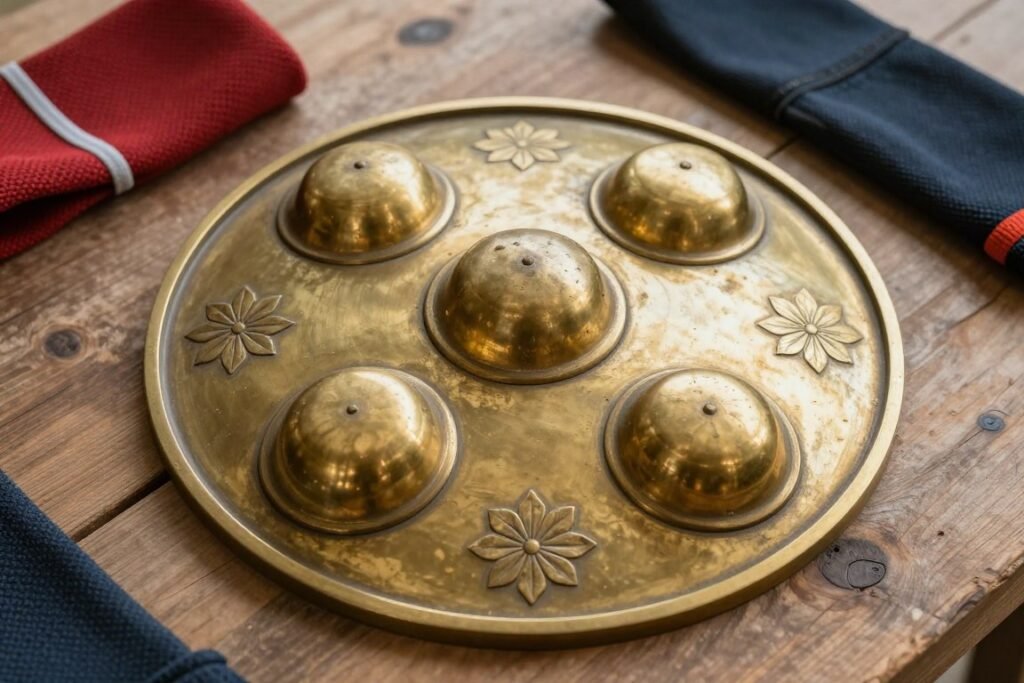
The curved surface of the dhal is engineered to deflect incoming blade and stick impacts away from the center line.
The phari is frequently paired with the soti in standard sport Gatka duels. Because the phari is lightweight and nimble, students use it like a reinforced glove to redirect incoming strikes with subtle wrist motions. This active shield work trains students to maintain active protection without blocking their own peripheral vision.
The dhal represents the historic battlefield standard, featuring four decorative central bosses that anchor inner retaining straps and an impact pad. In traditional combat routines, the curved face allows heavy strikes from swords, axes, or arrows to slide off harmlessly. Manipulating the dhal requires coordinated body drops and shoulder drives to brace against heavy blows while remaining balanced.
Edged Close-Combat Weapons and Ceremonial Daggers
Close-combat edged weapons occupy a significant place in Sikh history, reflecting the practical realities of historical battlefield warfare. While long weapons dominate open space, infighting requires specialized geometry that functions inside the reach of staffs and long swords.
In historical eras, warriors carried sidearms engineered for distinct offensive and defensive applications under armor. Understanding the physical differences among these weapons clarifies their historic tactical roles:
| Weapon | Form | Historic Grip | Tactical Application |
|---|---|---|---|
| Kirpan | Curved single-edge | Standard hilt | Defensive slicing and versatile close protection |
| Katar | Straight double-edge | Horizontal H-bar | Direct linear thrusting powered by body weight |
| Bichua | Double-curved blade | Loop handle | Hooking, trapped limbs, and close entanglement |
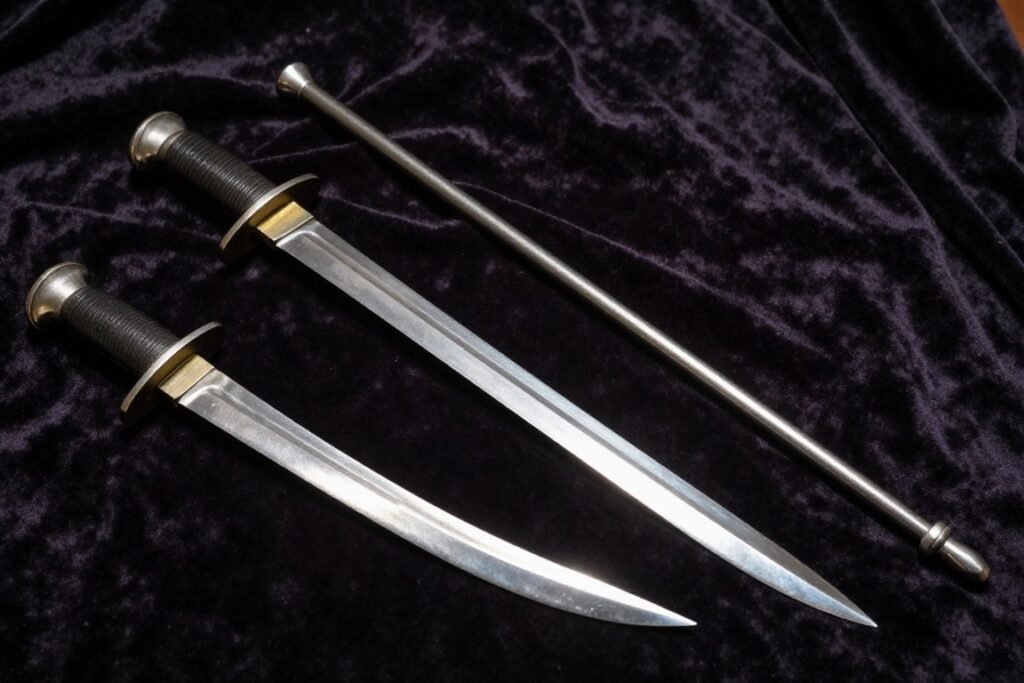
Close-quarters daggers provided alternative blade geometries engineered to exploit gaps in armor during melee combat.
The Kirpan — dagger/short sword holds an elevated, sacred position in Sikh identity as one of the mandatory articles of faith (the 5 Ks) carried by initiated Sikhs. Beyond its historic origin as a combat sidearm, the kirpan serves as a permanent spiritual reminder to oppose tyranny and protect those in distress. In ceremonial contexts, it represents defensive resolve, and it must never be treated as a casual training toy.
The Katar — punch dagger features an unmistakable design consisting of two parallel side bars connected by horizontal cross-grips. By gripping the crossbars, the blade aligns directly with the user’s forearm bones. This configuration transforms a simple forward punch into a penetrating thrust, utilizing the practitioner’s entire body weight rather than wrist strength.
The Bichua — curved dagger derives its name from the scorpion due to its double-curved silhouette and loop handle. The loop grip allowed the wielder to retain the dagger in the palm while still holding a shield strap or drawing another weapon. In grappling range, the curved edges permitted hooking motions around shields, parrying bars, or armor plates.
Training Safety and Weapon Progression
Modern Gatka training emphasizes strict safety standards to prevent unnecessary injuries during athletic practice. Instructors follow a staged progression that begins with basic stance work before any student touches wooden or metallic implements.
Footwork drills, known as pantra, are mastered with open hands to instill spatial awareness and rhythm. Once students show reliable balance, they advance to the soti and phari under supervised conditions to simulate sparring exchanges without sharp edges.
Practical martial arts training must always be conducted under the supervision of qualified instructors, using approved headgear, eye protection, and padded equipment.
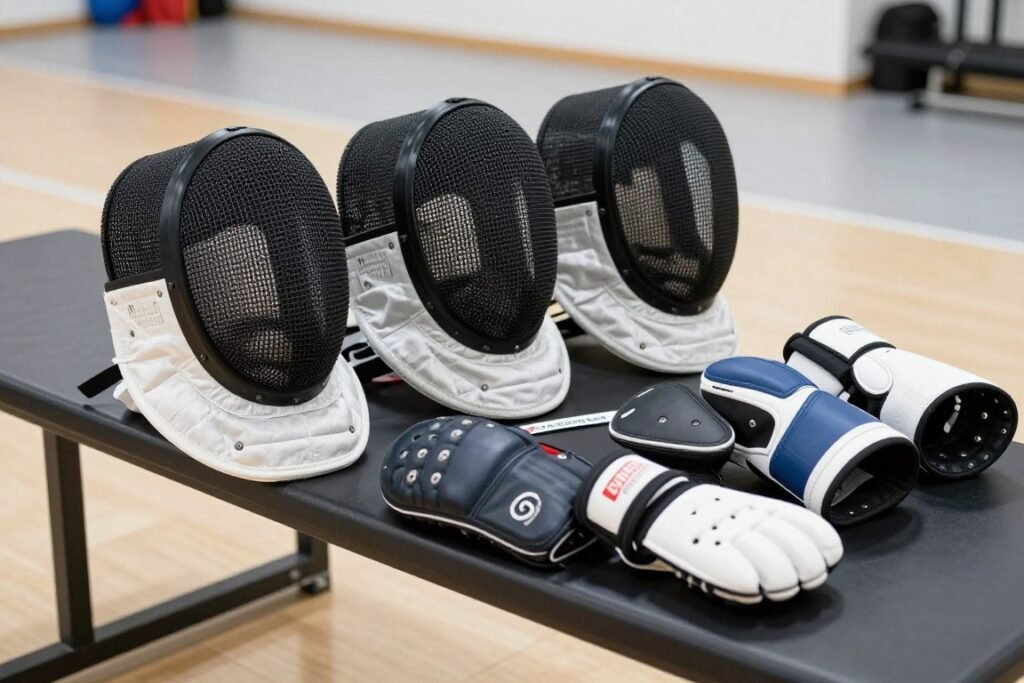
Modern sparring competitions utilize padded equipment and standardized rules to encourage athletic skill.
Metallic weapons, including historical swords, katars, and spears, are reserved exclusively for advanced choreographed forms (shastar vidiya) or ceremonial demonstrations. Novices never engage in free sparring with unpadded wooden weapons or steel edges. By separating dynamic athletic competition from historical weapons demonstrations, Gatka protects student safety while honoring Sikh heritage.
Frequently Asked Questions About Gatka Weapons
What is the difference between a soti and a marahati?
A soti is a hardwood training stick fitted with an integrated hand guard for sparring, while a marahati is a flexible, guardless bamboo stick used primarily for rapid rotational drills.
How does a katar function differently from a traditional dagger?
A katar features a horizontal grip and side bars that lock the blade in line with the forearm, allowing the user to deliver linear punch-thrusts driven by the body rather than relying on wrist flexion.
Are live steel weapons used in free Gatka sparring?
No, free sparring is conducted exclusively with padded sticks or soti and protective shields, while real steel weapons are restricted to controlled exhibitions, individual forms, and ceremonial displays.
Why is the kirpan considered distinct from ordinary combat daggers?
The kirpan is a sacred religious article of faith in Sikhism that symbolizes the moral duty to defend justice, distinguishing it from purely martial or sporting weapons.
What safety gear is mandatory for training with Gatka weapons?
Students use padded headgear with face protection, padded gloves, chest guards, and covered hand baskets on training sticks to prevent impact injuries.
Summary of Gatka Weapon Roles and Defensive Arts
Gatka weapons represent a structured martial continuum ranging from the perimeter control of the lathi staff to the close-quarter mechanics of the katar and bichua. Training implements such as the soti, marahati, and phari allow students to internalize continuous deflection and circular footwork without enduring unnecessary injury. Through respectful study, practitioners preserve the defensive philosophy and heritage passed down through generations of Sikh history. For a look at long range weapons check out this article.