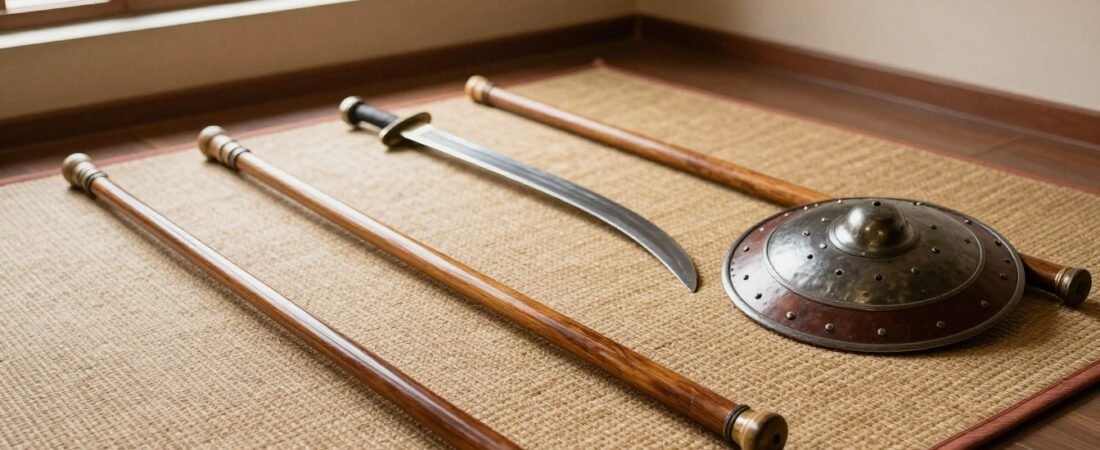
The choice between these arts rests on differences in physical expression, tactical focus, and historical context. Gatka emphasizes dynamic circular motion suited for multiple battlefield adversaries, whereas Kalaripayattu follows a rigorous curriculum that connects physical conditioning and animal postures directly to bladed weapon mastery.
The Role of Weapons in Gatka and Kalaripayattu
Weapons define the core identity of both systems, yet each art integrates weaponry into student development along completely different timelines. In Gatka, weapons practice begins almost immediately, teaching students rhythm, spatial awareness, and balance through stick drills before refining open-hand strikes. Kalaripayattu takes the opposite approach, requiring extensive periods of unarmed conditioning, body conditioning, and flexibility exercises before a student touches any weapon.
Gatka Weapon Integration
Students begin with lightweight sticks to understand the circular footwork known as the pantra. This early exposure builds peripheral vision and rapid coordination for crowd engagement, treating weapons as extensions of natural physical cadence.
Kalaripayattu Curricular Progression
Instruction follows four strict stages: Meipayattu for physical control, Kolthari for wooden weapons, Angathari for sharp metal blades, and Verumkai for empty-hand self-defense. Metal weapons enter the curriculum only after total body control is mastered.
Historical context also influenced whether these tools served primary battlefield duties or cultural preservation. Gatka weapons evolved during intense periods of defense against persecution, producing durable arms meant for chaotic combat that later transitioned into ceremonial and community practice. Kalaripayattu weapons originated within formal military academies called kalaris, where combat techniques merged with Ayurvedic medicine, marma vital point theory, and ritual performance.
Gatka Staff vs. Kalaripayattu Kettukari and Stick Weapons
Wooden weapons form the instructional foundation in both disciplines, bridging the gap between basic motor control and bladed combat. Gatka employs the soti, a leather-covered or rattan training stick fitted with a broad handguard, alongside longer poles such as the lathi and the curved marahati stick. Kalaripayattu utilizes the kettukari, a long staff made of dense wood matching the practitioner’s height, as well as the cheruvadi, an agile short stick designed for high-speed parries.
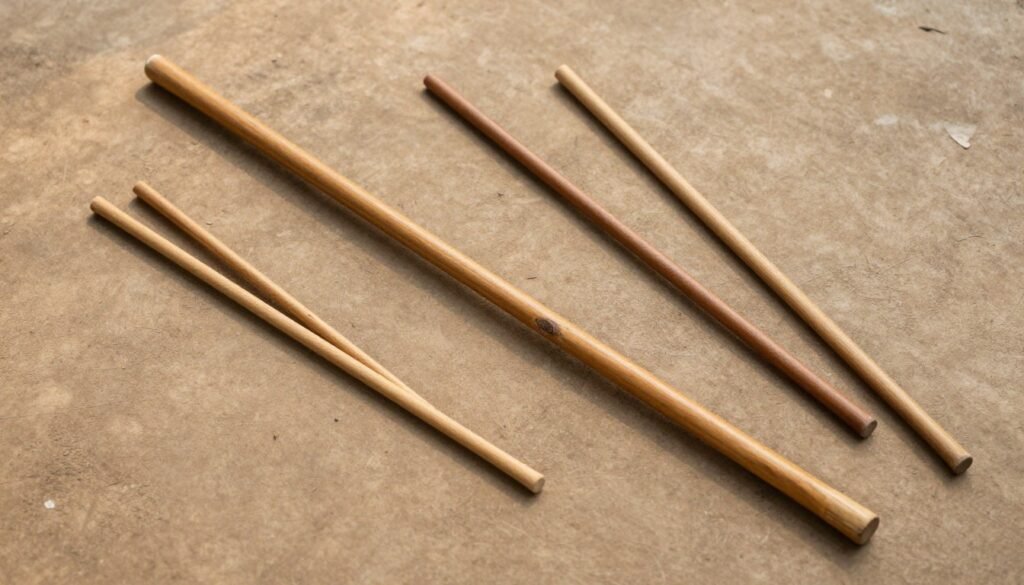
Wooden staffs and sticks introduce practitioners to essential concepts of leverage, defensive deflection, and timing.
| Weapon | Art | Primary Function | Mechanical Characteristics |
|---|---|---|---|
| Soti | Gatka | Sparring training | Padded or rattan stick with a broad hilt for safe contact drills. |
| Lathi | Gatka | Distance defense | Long hardwood pole swung in continuous arcs to manage space. |
| Kettukari | Kalaripayattu | Staff mastery | Full-body height hardwood staff used for thrusts and linear blocks. |
| Cheruvadi | Kalaripayattu | Rapid infighting | Short, thick wooden baton swung in rapid combination strikes. |
The tactical application of these wooden weapons highlights divergent movement patterns. Gatka stick fighting uses continuous circular trajectories that harness rotational momentum to deflect strikes while repositioning the body. Kalaripayattu staff methods rely on direct linear thrusts, grounded low stances, and rapid shifts between animal postures to target vulnerable joints and nerve centers.
Gatka Talwar vs. Kalaripayattu Val
Sword arts reveal the clearest mechanical contrast between the martial traditions of northern and southern India. The signature sword of Gatka is the talwar, a curved single-edged blade fitted with a distinctive disc-shaped pommel that locks the wrist into an aligned position for powerful drawing cuts. In Kalaripayattu, the primary edged weapon is the val, a double-edged straight or gently tapering sword engineered for rapid slashing and accurate thrusting.
Gatka talwar manipulation focuses on fluid drawing slices powered by shoulder rotation and rhythmic footwork. The specialized hilt prevents excessive wrist flexion, which helps protect the joint during heavy impacts against armor or dense shields.
Alongside the val, Kalaripayattu features the urumi, a flexible whip-like sword constructed from one or more strips of spring-tempered steel. The urumi requires continuous, high-speed swirling motions around the wielder’s body to generate cutting power while preventing the blade from rebounding against the practitioner. This weapon demands exceptional balance and flexibility, presenting higher technical difficulty and safety risks than the rigid blades of Gatka, such as the broad tega sword.
Gatka Dhal vs. Kalaripayattu Shield Traditions
Shields in both traditions serve as offensive implements rather than passive protective walls. Gatka practitioners pair their swords with the dhal, a convex circular shield traditionally constructed from seasoned hide, brass, or steel, equipped with twin interior straps. Kalaripayattu relies on the paricha, a rounded wooden or metal buckler designed to fit snugly against the forearm during agile maneuvering.
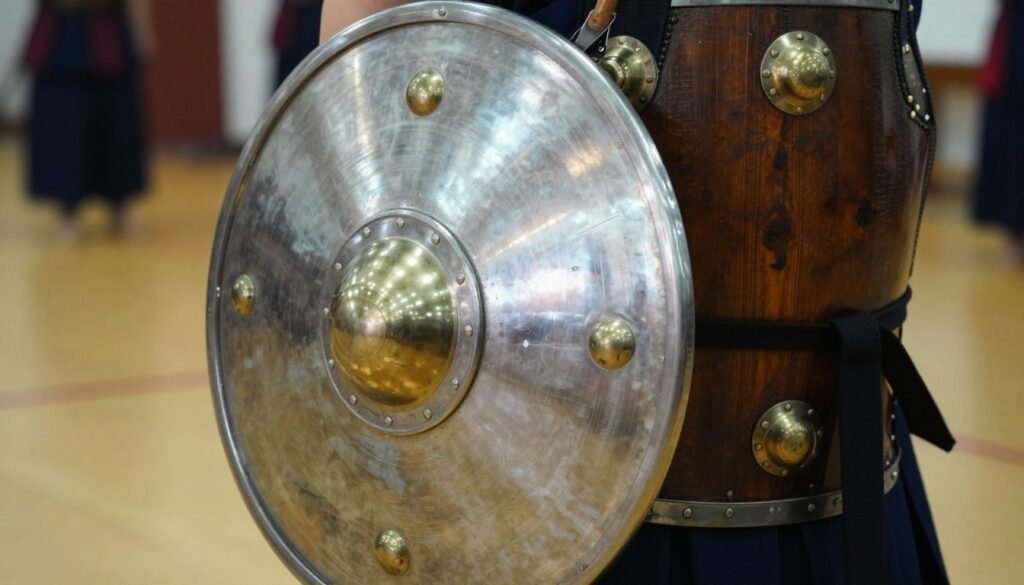
Circular shields in Indian martial arts provide agile deflection surfaces that feed directly into counter-striking combinations.
Gatka Dhal Dynamics
- Convex curvature deflects blade cuts outward.
- Twin handle grips allow rapid angle adjustments.
- Rim serves as a striking edge against opponents.
- Coordinates with circular footwork to maintain defense.
Kalaripayattu Paricha Dynamics
- Compact diameter allows unobstructed high agility.
- Reinforced central boss absorbs heavy straight impacts.
- Close forearm fit enables rapid low-line parries.
- Integrates with low crouching lunges and leaps.
During sparring or battlefield skirmishes, both arts use the shield rim to strike the opponent’s face, unbalance their guard, or pin their weapon arm. The dhal deflects heavy blows to set up immediate counter-cuts with the talwar, whereas the paricha works in tight unison with the val to clear attack lanes during deep lunges.
Close-Quarter Arms: Gatka Katar and Kalaripayattu Kattari
Daggers in Indian martial systems represent specialized engineering for extreme close-quarters fighting, armored encounters, and personal protection. Gatka features several short weapons, including the kirpan, a culturally significant curved dagger worn as an article of faith, and the bichua, an undulating blade named after a scorpion stinger. Gatka also includes the iconic katar, a punch dagger featuring parallel grip bars that direct the user’s full skeletal power directly into a straight thrust.
Northern Push Daggers
The katar locks the blade perpendicular to the fist, allowing the user to deliver powerful forward thrusts capable of piercing chainmail or dense textiles during grappling exchanges.
Southern Curved Blades
The kattari in Kalaripayattu emphasizes curved cutting arcs and pinpoint thrusts directed at vulnerable nerve junctions and arteries identified through the study of marma points.
While the Gatka katar turns close-range fighting into an aggressive mechanical drive forward, Kalaripayattu dagger tactics focus on evasion, joint redirection, and quick angle changes. The southern kattari functions as a concealed tool for disabling an assailant with minimal movement, relying on precise angles rather than overwhelming forward impact.
Battlefield Reach: Barchha, Neja, and Kuntham Spears
Spears and polearms represented the decisive weapons on historical Indian battlefields, offering extended reach against infantry lines and mounted cavalry. Gatka incorporates the barchha, a heavy thrusting spear fitted with an elongated, reinforced steel blade, alongside the neja, a slender, highly mobile cavalry lance. Kalaripayattu uses the kuntham, a balanced spear constructed with a tapered hardwood shaft and an agile leaf-shaped point.
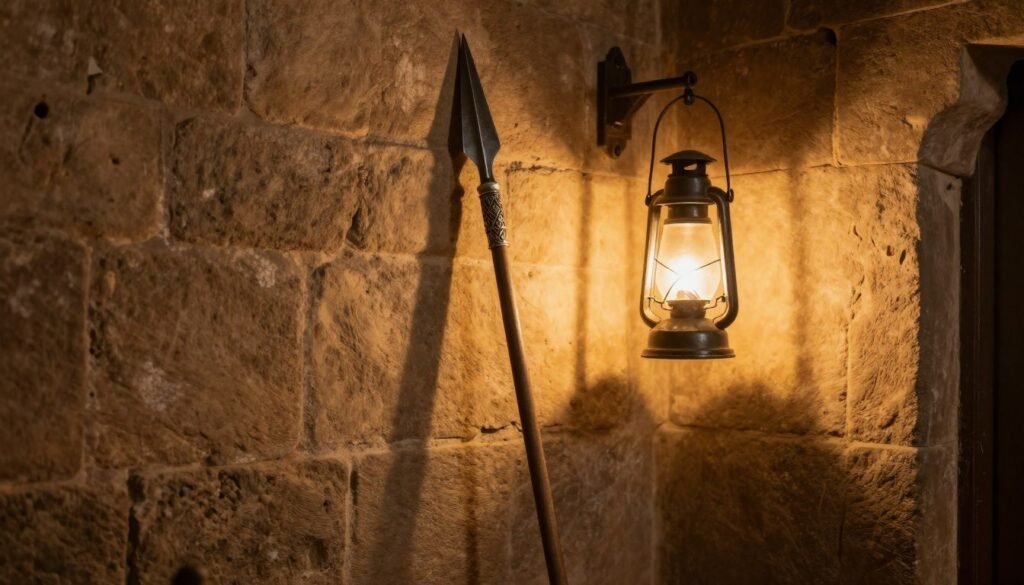
Spear training refines whole-body extension, balance recovery, and spatial control across both traditions.
Long polearm combat relies heavily on two-handed control to produce rapid thrusting combinations, while single-handed extensions maximize reach when engaging mounted opponents or maintaining distance against multiple assailants.
Gatka spear work reflects open-field tactics where wide sweeping motions clear space around the practitioner before driving straight into an armored target. In contrast, Kalaripayattu kuntham forms stress low-profile thrusting sequences, agile defensive withdrawals, and rapid rotations that redirect an opponent’s weapon along the shaft before driving into exposed vital zones.
Unique Weapons: Cultural Philosophy and Specialization
The specialized weapons developed within each system highlight their contrasting strategic environments and tactical priorities. Gatka incorporates the chakar, a circular steel disc equipped with cords and weighted ends that spin continuously to create an impenetrable defensive perimeter against charging opponents. It also employs the tabar, a battle axe designed to penetrate heavy armor, and the gurj, a flanged steel mace built to crush armored helmets and shields.
Gatka Kinetic Perimeter Weapons
Weapons like the chakar and the heavy tega execution sword reflect an operational reality focused on perimeter defense, crowd containment, and decisive heavy impacts against fortified cavalry and infantry lines.
Kalaripayattu Biomechanical Tools
The urumi and the otta, an S-curved wooden horn designed to target pressure points, reflect deep anatomical knowledge where weapon curves follow natural human movement and physiological vulnerabilities.
These unique weapons demonstrate that martial development never occurs in isolation. Gatka arms arose from frontline necessity during prolonged campaigns across open northern plains, demanding tools capable of defeating diverse defensive equipment. Kalaripayattu weapons evolved within dedicated training grounds where deep anatomical study enabled practitioners to use flexible steel and curved wood with surgical accuracy.
Shared Foundations Across Indian Weapon Traditions
Despite their geographic separation and differing arsenals, Gatka and Kalaripayattu share profound foundational principles that define indigenous Indian martial arts. Both systems reject passive blocking, training practitioners to treat defense as an offensive movement that simultaneously parries an attack while closing distance. Additionally, both arts integrate footwork patterns where every arm strike draws kinetic force from pelvic rotation and balanced ground contact.
Integrated Weapon Training
Neither art views weapons as isolated tools; both use wooden sticks, sharp blades, and shields as continuous extensions of the practitioner’s natural body mechanics.
Dual Offensive Defense
Parries are executed along angled planes that deflect incoming force while instantly feeding into counter-strikes without pauses or resets in momentum.
Cultural and Spiritual Roots
Both traditions integrate martial practice with spiritual discipline, ethical conduct, and respect for weapons, viewing training as mental and physical cultivation.
Each art also serves cultural functions that extend beyond combative victory. Weapons training in Gatka reinforces community resilience, spiritual grounding, and historical remembrance within Sikh identity. Similarly, Kalaripayattu maintains strong connections to sacred rituals, theatrical dance forms like Kathakali, and traditional Ayurvedic medicine, preserving holistic mind-body discipline across generations.
Structural and Tactical Distinctions
Examining the structural execution of both arts clarifies their contrasting combat philosophies. Gatka emphasizes upright, agile footwork with circular perimeter coverage, enabling a single practitioner to transition smoothly between multiple attackers. Kalaripayattu uses low animal postures, explosive linear lunges, and deep compressions that generate cutting power directly from the ground up.
| Dimension | Gatka | Kalaripayattu | Practical Distinction |
|---|---|---|---|
| Geographic Origin | Punjab (North) | Kerala (South) | Northern open-plains combat versus southern kalari enclosure. |
| Core Footwork | Upright pantra | Animal vadivu | Rhythmic circular pacing versus grounded low-profile stances. |
| Primary Sword | Curved talwar | Straight val & urumi | Draw-cutting momentum versus linear thrusts and flexible whipping. |
| Modern Expression | Sikh festivals & sport | Stage art & fitness | Community martial performance versus physical theater and wellness. |
The progression of weaponry further illustrates these strategic differences. A Gatka student acquires weapon literacy early to build battlefield reflexes and spatial awareness under stress. A Kalaripayattu student must first cultivate extreme joint mobility, core stability, and mental poise through unarmed forms before progressing through wooden and bladed arsenals.
Which Has the Greater Variety of Weapons?
When comparing weapon variety between the two arts, catalog size does not determine martial effectiveness. Gatka draws from a broad northern arsenal shaped by Indo-Persian, Rajput, and Mughal influences, yielding a large variety of heavy maces, flanged axes, recurve bows, punch daggers, and cavalry sabers. Kalaripayattu maintains a focused, highly specialized curriculum of wooden staffs, straight swords, curved daggers, and flexible blades refined over centuries.
Gatka prioritizes breadth across diverse combat instruments to prepare fighters for varied battlefield weapons, while Kalaripayattu emphasizes specialized depth, mastering a streamlined selection of weapons through intensive biomechanical conditioning.
Gatka’s breadth allowed historical warriors to adapt quickly to captured arms or changing frontline conditions. Kalaripayattu’s specialization develops mastery over distinct physical demands, culminating in the complex dynamics of the flexible urumi. Both methods achieve combative sophistication through completely different educational philosophies.
What Gatka and Kalaripayattu Tell Us About Indian Martial Arts
The weapon traditions of Gatka and Kalaripayattu illustrate the remarkable diversity of combat systems developed across the Indian subcontinent. Rather than following a single dogmatic template, Indian martial traditions adapted their tools to local geography, climate, armor types, and cultural values. Northern traditions engineered robust, momentum-driven weapons to engage armored opponents across open terrain, while southern schools refined anatomical accuracy, low-profile evasion, and flexible steel within tropical environments.
Environmental Adaptation
Regional weapon forms reflect the practical realities of their home terrain, from the cavalry-dominated expanses of the north to the dense, humid landscapes of the south.
Living Heritage
Both traditions have successfully moved beyond battlefield survival, thriving today as living cultural practices, competitive sports, and systems of physical fitness.
Studying both systems reveals a shared dedication to balance, spatial control, and mindful movement. Whether wielding the curved talwar of Punjab or the flexible urumi of Kerala, practitioners of both arts preserve sophisticated historical legacies that continue to inspire martial artists worldwide.
Frequently Asked Questions
Which weapon is taught first in Gatka and Kalaripayattu?
Gatka instructors introduce the padded or rattan soti stick right at the beginning of training. In Kalaripayattu, students must first complete comprehensive unarmed conditioning before advancing to the kettukari long staff.
Why is the Kalaripayattu urumi considered exceptionally difficult to master?
The urumi consists of flexible spring-steel blades that behave like whips during high-speed rotation. Without continuous motion, strict balance, and precise body control, the blade can easily recoil and injure the practitioner.
Is the Gatka talwar primarily a thrusting or cutting sword?
The talwar is engineered primarily for draw cuts and slicing strikes. Its curved blade profile and fixed disc pommel optimize cutting mechanics while limiting wrist flexibility for forward thrusts.
Are these traditional weapons still used in modern practice?
Modern practitioners continue to train with both wooden and metal weapons during cultural demonstrations, athletic tournaments, and traditional academy sessions. Unsharpened blades and protective gear help minimize injury during contemporary sparring.
Preserving India’s Weapon Heritage
Gatka and Kalaripayattu demonstrate how distinct regional histories produced equally sophisticated, highly practical approaches to traditional weapon combat. From the rhythmic circular sweeping strikes of the Punjabi talwar to the precise, flexible dynamics of the Kerala urumi, each discipline preserves vital historical knowledge. Exploring these traditional arms deepens appreciation for the technical diversity, tactical depth, and enduring cultural value of Indian martial arts.