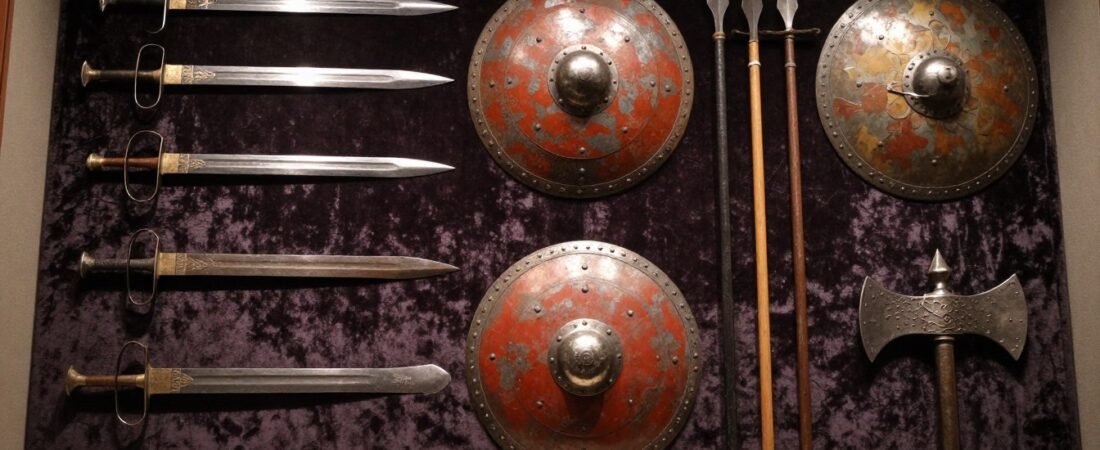
Weapon selection in classical training depends on tactical range, opposing armor, footwork dynamics, and the physical conditioning of the practitioner. Understanding the technical morphology and martial purpose of each implement clarifies how historical fighters transitioned between hand-to-hand engagement and ranged skirmishing.
Historical and Cultural Foundations of Gatka Weapons
The practice of Gatka emerged within the northern Indian subcontinent as an accessible martial tradition deeply tied to Sikh history and defensive preparedness. Weaponry within this tradition is viewed not merely as military equipment, but as historical artifacts representing resilience, personal discipline, and spiritual duty. Classical battlefield arts, historically referred to as Shastar Vidya, evolved over centuries as regional conflicts necessitated structured weapon defense for community protection.
Sixth Sikh Guru, Guru Hargobind, established the concept of Miri and Piri, formalizing martial preparedness alongside spiritual devotion. Later, Guru Gobind Singh institutionalized martial training among the Khalsa, establishing centers where weapon maintenance, archery, swordsmanship, and horsemanship were practiced systematically. Over successive generations, community gatherings and martial demonstrations preserved these weapon arts through defined forms and combat exercises.
Weapon forms and nomenclature often vary by regional lineage, oral tradition, and historical texts across northern India. While individual akhadas (training halls) maintain specialized grips or naming conventions, the structural archetypes of these weapons remain consistent across traditional lineages.
During the colonial era, traditional arms carrying faced severe legal prohibitions, which led to the adoption of standardized wooden training sticks known as soti. This pedagogical shift permitted practitioners to retain complex footwork, parrying angles, and target strikes without open public carry of live steel blades. In contemporary settings, Gatka is demonstrated at cultural festivals and recognized in competitive platforms like the Khelo India youth games, preserving technical familiarity with classical weaponry.
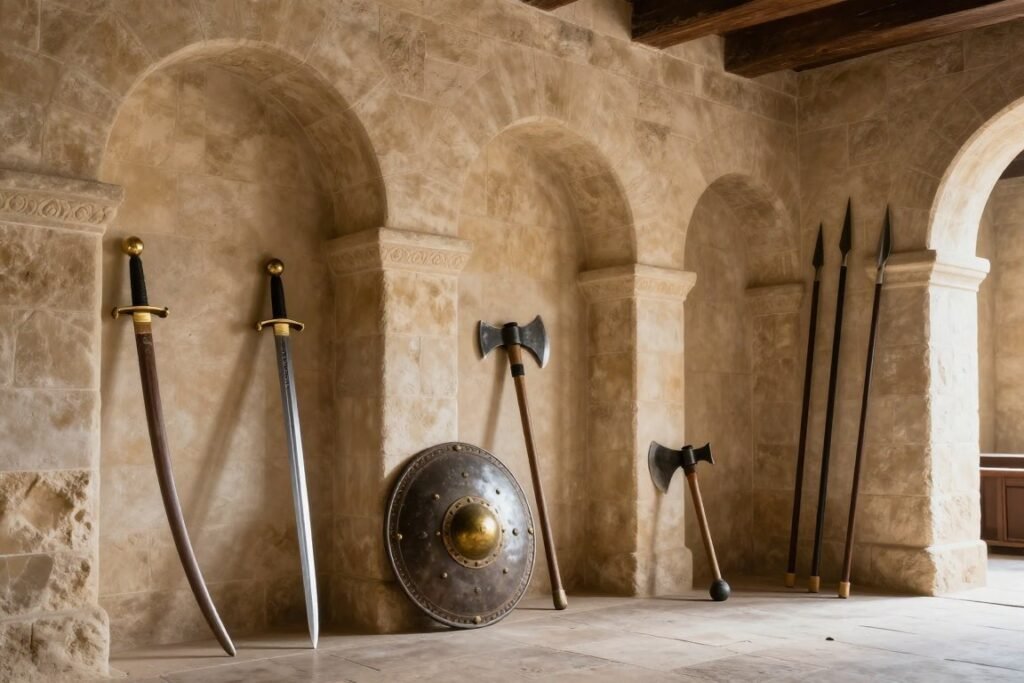
Traditional Swords in Gatka: Talwar and Tega
Edged weapons form the core foundation of Gatka swordsmanship, dictating the circular footwork and flowing body mechanics characteristic of the system. Practitioners learn fundamental defensive parries, cuts, and thrusts with swords designed for varied tactical situations on the battlefield.
The primary single-handed swords in Gatka include two distinct edged designs, each offering specific balance properties, cutting mechanics, and structural characteristics:
Talwar / Talwaar — curved sword
- Moderate curve optimized for fluid draw-cuts and draw-slashes.
- Fitted with a disc-pommel grip that secures the wrist during lateral movement.
- Balanced for quick recovery between successive parries and offensive strikes.
- Functions as the primary single-handed combat sword across traditional forms.
Tega — long, broad sword
- Substantially wider, heavier steel blade engineered for forceful cleaving power.
- Excels against heavier garments, layered armor, and reinforced defensive lines.
- Demands deliberate kinetic transfer from the hips, core, and planted feet.
- Sacrifices rapid directional reset in exchange for maximum impact momentum.
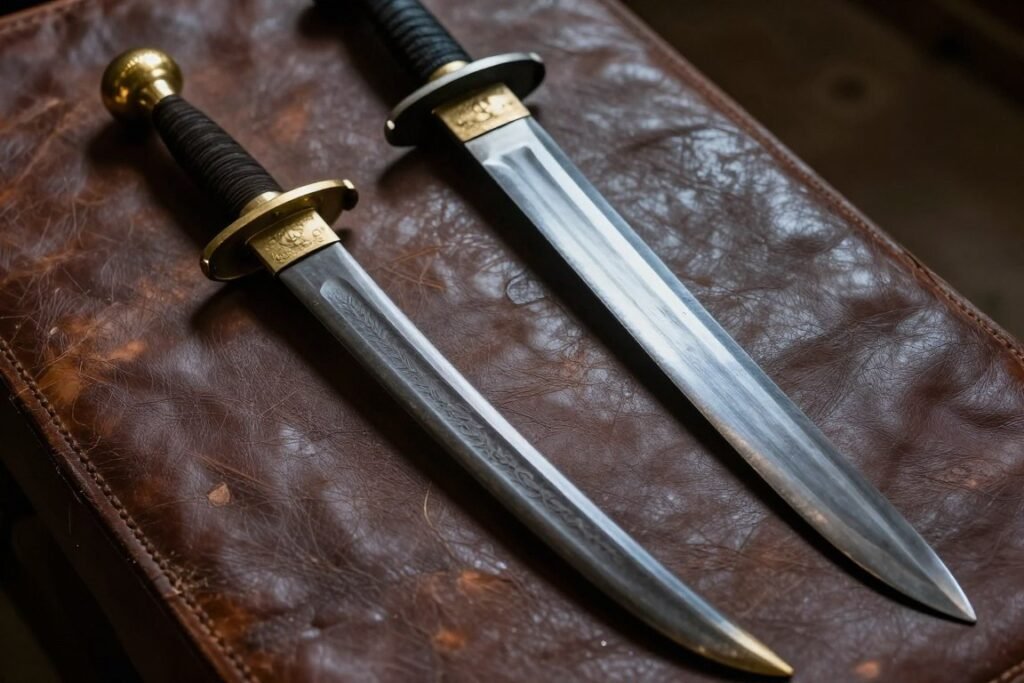
The Talwar / Talwaar — curved sword represents the most widespread sidearm in classical Indian martial combat. The curvature of the steel blade reduces drag during slicing motions, enabling continuous movement through defensive lines. The distinctive hilt features a circular pommel plate that locks the fighter’s wrist at a specific angle, discouraging flexible wrist flicks in favor of whole-arm cuts driven by footwork.
In contrast, the Tega — long, broad sword possesses an expanded blade profile that widens noticeably toward the tip or along the belly of the cutting edge. This concentrated mass shifts the balance point further forward down the blade, generating intense downward momentum. A practitioner wielding a tega relies on wide rotational arcs and firm stances to drive the heavy blade through resilient defensive barriers.
Impact and Cleaving Arms: Guraj and Tabar
When encountering mail shirts, plate armor, or reinforced shields, edged swords could suffer edge deformation or deflection. Gatka warriors historically incorporated blunt impact weapons and specialized cleaving axes capable of delivering concussive trauma through defensive armor.
These heavy melee weapons require dedicated body alignment, core stability, and careful timing due to the physical recovery time required after an executed swing:
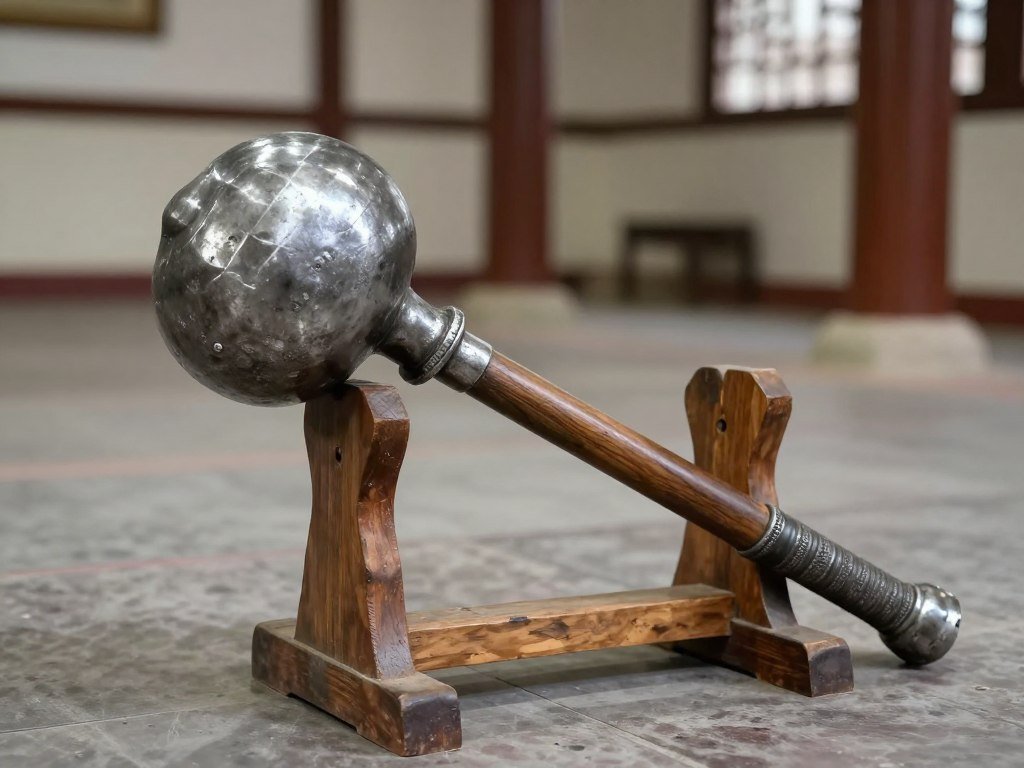
Guraj / Gurj — mace
A heavy fluted or spherical striking head mounted on an iron or reinforced wooden shaft. The weapon transmits crushing force directly through helmet plates and reinforced breastplates without requiring an aligned cutting edge.
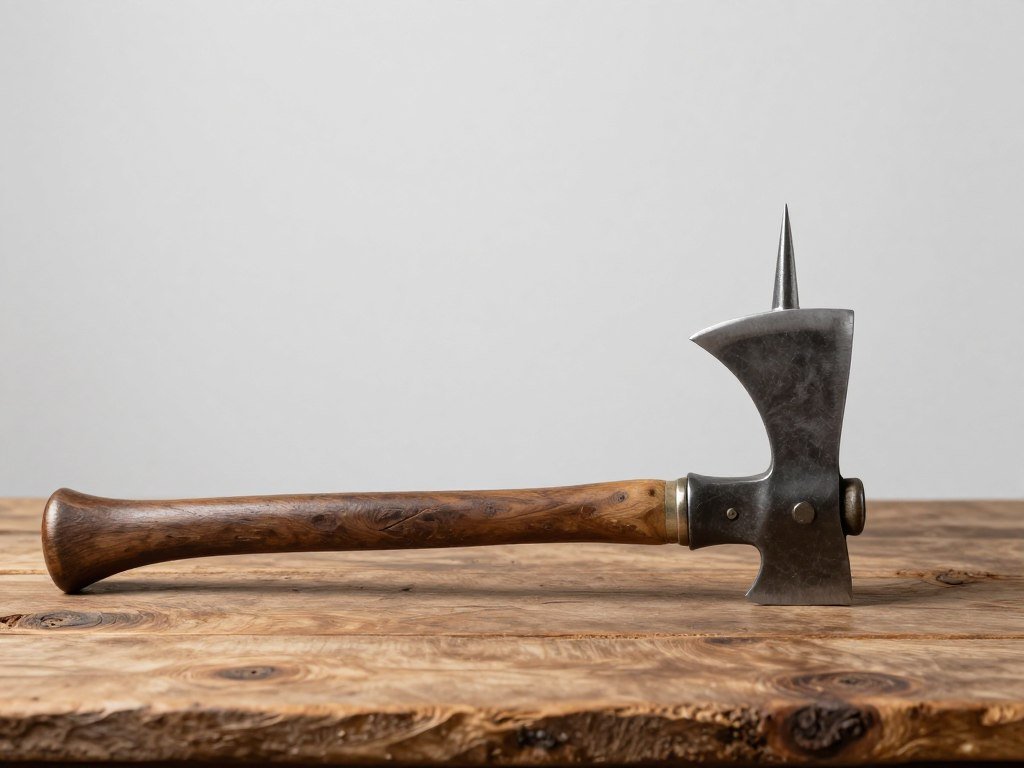
Tabar — axe
A crescent-shaped steel blade affixed to an elongated handle, often balanced by a rear hammer face or spike. It focuses kinetic energy into a narrow impact boundary to split reinforced wooden bucklers and armor joints.
The Guraj / Gurj — mace delivers concussive shock through structural mass rather than sharpness, making it devastating against rigid protective gear. Maneuvering a gurj requires powerful circular hip drives and shoulder engagement, as missed blows can leave an operator vulnerable to swift counter-thrusts. Some variants feature pointed steel spikes or internal rattle balls, though the primary function remains concussive blunt impact.
The Tabar — axe combines the concussive weight of a hafted tool with a sharpened cutting edge. The concentrated mass directly behind the crescent blade permits deep penetration into hard targets with minimal deflection. In two-handed or single-handed handling, the tabar allows hooked traps against opposing blade guards, shields, and pole shafts during tight melee scrambles.
Thrusting Polearms: Barchha and Neja
Polearms provided critical stand-off range against mounted adversaries, cavalry charges, and infantry lines. In the open field, maintaining distance prevented an opponent from closing within sword range, giving long thrusting shafts an irreplaceable defensive role.
Gatka training preserves specific spear and javelin handling techniques, maintaining distinct physical archetypes for close-formation bracing versus mobile, open-field deployment:
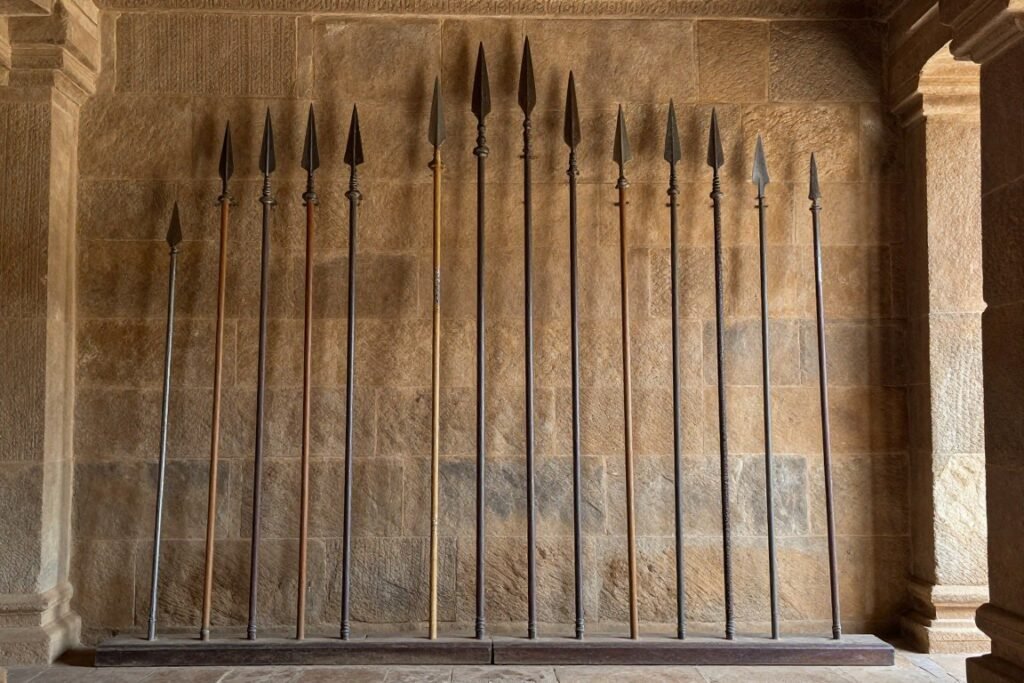
- Barchha / Barcha — spear: A long-shafted, heavy infantry thrusting spear engineered with an elongated broad steel head for piercing defenses.
- Neja — javelin: A lighter, balanced throwing and thrusting spear utilized by mobile skirmishers and mounted cavalry riders.
- Reach Superiority: The extended shaft allows defensive strikes well outside the reach of one-handed blades and maces.
- Two-Handed Control: Leveraged hand positions permit rapid directional changes, deflections, and counter-thrusts along the shaft axis.
- Dual-End Utility: Traditional practitioners use the butt spike or counterweight ferrule to parry low strikes and sweep an attacker’s balance.
The Barchha / Barcha — spear is typically designed as a substantial thrusting polearm meant for grounded two-handed leverage. Its blade can range from triangular armor-piercing bodkin styles to wide leaf shapes capable of both cutting and deep puncture wounds. When facing charging cavalry, grounding the butt end of the barchha against the earth created an immovable defensive barrier.
The Neja — javelin features a lighter, more streamlined profile designed for dynamic handling, swift one-handed throws, or high-mobility thrusting from horseback. The balance point sits closer to the center, facilitating accurate flight over medium distances or agile close-quarter recovery. Skirmishers deployed the neja to disrupt advancing ranks before drawing close-quarter weapons like the talwar.
Ranged and Projectile Systems: Teer and Chakar
While Gatka is often recognized for close-quarters blade demonstrations, historical Sikh combat doctrine placed immense value on long-range projectile superiority. Mastery of distance weapons allowed warriors to suppress opposing forces before hand-to-hand engagement occurred.
Traditional ranged systems within Gatka encompass both conventional archery components and distinctive rotational aerodynamic projectiles:
| Weapon | Delivery Type | Primary Function | Design and Tactical Characteristics |
|---|---|---|---|
| Teer — arrow | Bow-drawn | Precision piercing | Paired with composite or steel bows to strike distant targets through armor plates. |
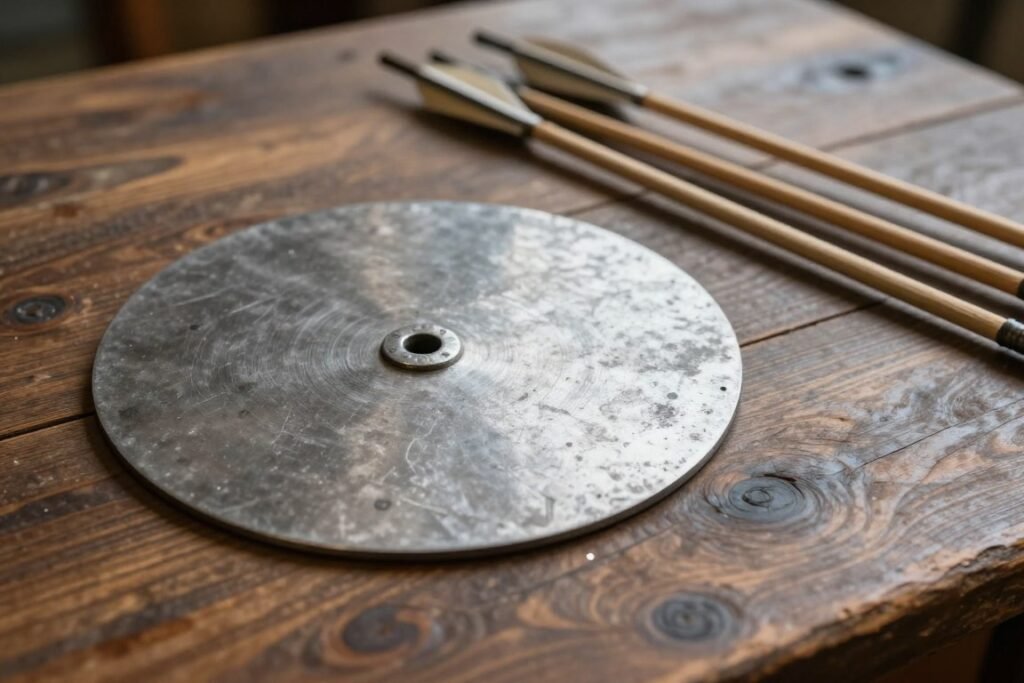
| Chakar / Chakra | Thrown or spun | Area harassment | A steel throwing ring or ring with weighted wooden balls used to disrupt ranks. |
The Teer — arrow served as the lethal ammunition of the classical composite bow (kaman) and all-steel Indian bows. Arrows featured varying tip geometries, including broadheads for soft targets, chisel-shaped bodkins for mail penetration, and crescent tips designed to sever rigging or target extremities. Historical records document exceptional emphasis placed on rapid archery drills and long-distance accuracy among Khalsa warriors under Guru Gobind Singh.
The Chakar / Chakra — steel throwing ring / ring with weighted wooden balls represents one of the most distinctive weapons in the Punjabi martial tradition. In its classical flat steel form (often termed chakram), the outer circumference features a razor edge launched with high-speed rotational flicking from fingers or twirled overhead on a central rod. In alternative training and skirmishing variations, cords radiating from a central frame support weighted wooden balls, spun continuously at high speeds to establish a protective barrier against multiple converging attackers.
Training Progression and Weapon Characteristics in Practice
Modern Gatka methodology maintains a structured instructional path that guides a student from non-lethal equipment to live steel handling. Novices begin with basic body movement, stance transitions, and fluid footwork patterns before interacting directly with simulated or live weaponry.
Initial training relies primarily on the soti, a flexible bamboo or hardwood stick that simulates the length, balance, and defensive lines of a curved sword. Paired with a small leather buckler shield known as a phari, students drill attack angles, deflections, and return counters without excessive risk of cutting injuries. This methodology helps build continuous muscle memory, spatial awareness, and rotational velocity.
Live steel weapons are introduced only after a student displays consistent control over body mechanics, recovery angles, and distance management. Handling the weight of a live tega or guraj demands physical conditioning distinct from the lighter wooden soti.
The translation from wooden practice implements to live steel requires adjusting for weapon mass, blade alignment, and the risk of binding. While bamboo bounces on impact, steel edges can bite, catch, or slide along opposing blades, requiring refined wrist tension and blade geometry control. Gatka practitioners continually integrate these classical tools to maintain the living technical heritage of historical Sikh martial science.
Frequently Asked Questions
What is the main difference between a Talwar and a Tega in Gatka?
A Talwar features a moderately curved blade balanced for rapid slicing and fluid recovery, while a Tega has a broad, heavy blade designed for forceful cleaving strikes. The Tega carries more weight toward the tip, producing greater downward momentum at the expense of directional agility.
How does a Chakar function as both a throwing and rotational weapon?
In solid steel form, the Chakar is an aerodynamic disc thrown with high spin to slice across distance. When constructed as a wheel with cords and weighted balls, it is spun overhead or around the body to create a continuous defensive barrier against approaching adversaries.
Why did bamboo sticks replace steel swords in standard Gatka training?
Legal restrictions under British colonial rule prohibited the public carry of live steel arms across the region. Adopting the wooden soti allowed practitioners to preserve classical movement patterns, strikes, and tactical drills without violating weapon bans.
What tactical role did polearms like the Barchha and Neja serve?
Polearms provided critical stand-off distance against mounted cavalry and massed infantry charges. The heavy Barchha anchored stationary defense, while the lighter Neja enabled rapid throwing or agile thrusts during fluid skirmishes.
Is Gatka identical to historical Shastar Vidya?
Gatka is generally regarded as an accessible, structured branch derived from broader classical Shastar Vidya battlefield traditions. While Gatka emphasizes stick play, paired forms, and public demonstrations, Shastar Vidya historically encompassed open-field military strategy and lethal combat methods.
Conclusion
The traditional weapons of Gatka reflect a sophisticated martial science that balanced close-quarters combat, heavy armor defeat, and ranged tactical engagement. From the fluid geometry of the curved Talwar to the concussive force of the Guraj and the aerodynamic precision of the Chakar, each weapon embodies a functional response to historical battlefield conditions. Preserving these tools through structured training honors the enduring cultural and defensive heritage of Sikh martial traditions. For learn more about the weapons used in close combat click here.